Fields, animals, and woodlot
The Farm
This land has been farmed since the 1770s. Today oxen and horses do the heavy work in the hayfields, the corn and flax fields, and the woodlot, and the farm grows what the kitchen, the mills, and the studios use.
Parts of the farm
Draft power
Oxen and horses
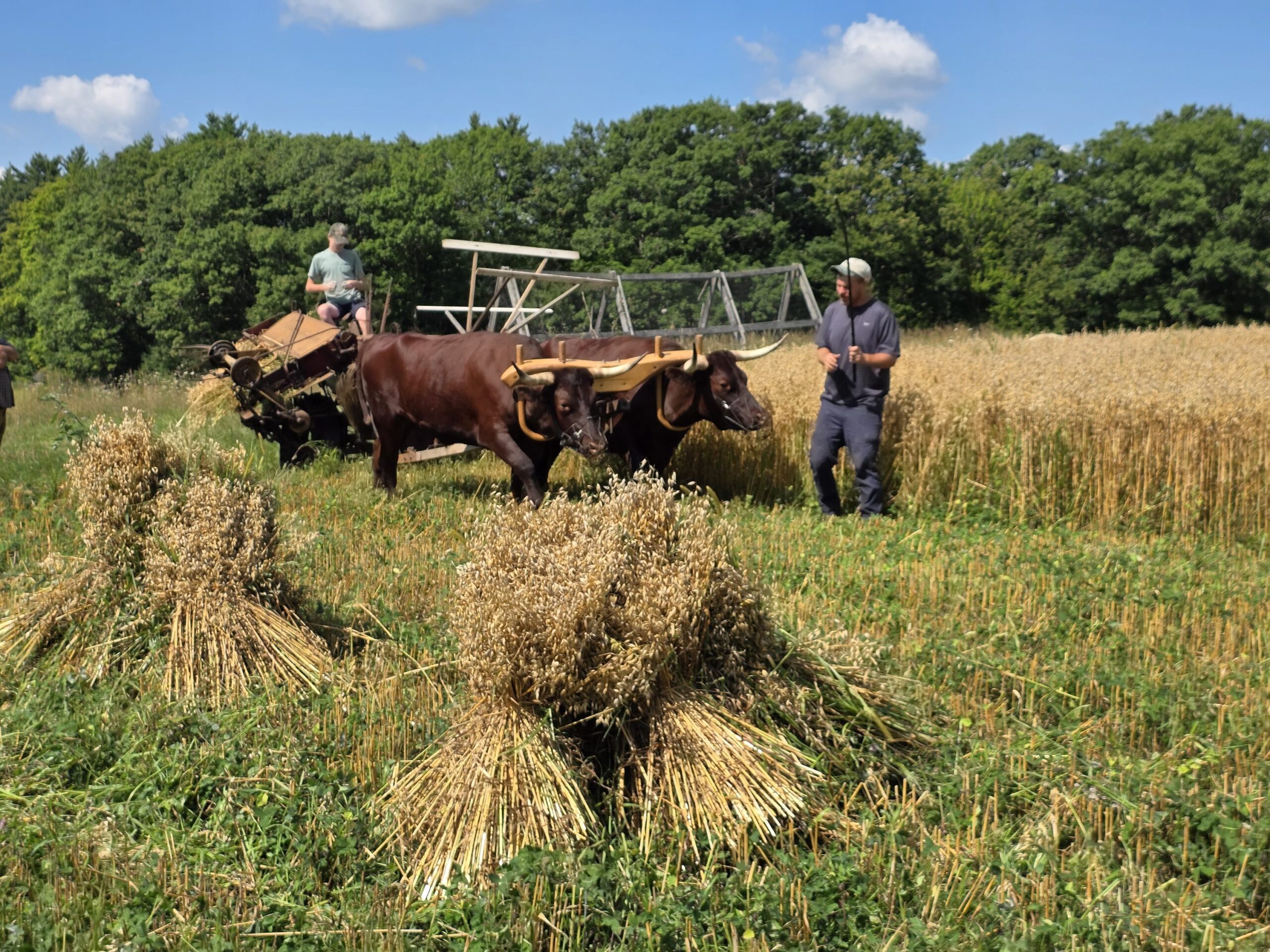
Oxen and horses do the farm’s heavy work: they plow and haul in the fields and move logs out of the woodlot. They eat most of the hay the farm grows, and their manure goes back onto the fields as fertilizer.
The farm works three teams of oxen: Rough and Tough and Chase and Rubble, both Devons, and Buck and Blaze, Brown Swiss and Holstein crosses.
The Barden Barn, named for a horse logger, is the horse barn, and oxen workshops meet in the Grano Barn. Visitors can watch a team at work during the logging demonstrations listed on the events calendar.
Draft Animals
Oxen
Three teams: two of Devons, one of Brown Swiss and Holstein crosses
Teamster
Tyler Allen, Livestock Supervisor & Oxen Teamster
Barns
Barden Barn (horses), Grano Barn (oxen workshops, hay)
Teams
Rough and Tough, Chase and Rubble, Buck and Blaze
The fields
Hay, corn, flax, and the market garden
Sixty-five acres of hay are cut twice a year, in late spring and late summer, baled, and stored in the Grano Barn. Most of it feeds the draft animals.
Corn is ground at the grist mill into feed and corn flour. For a time, a small share went to Cold Garden Spirits in Canterbury for a corn whiskey. Flax is grown for the fiber studios, where students learn to dress it and spin it into linen. Vegetables, melons, and fruit grow in hoop houses and open ground for the CSA, alongside older trees that include heritage apples.
The farm saves seed, rotates crops, and returns the animals’ manure to the soil.
The Fields
Hay
65 acres, cut twice a year
Grain
Corn for feed and flour
Fiber
Flax for the fiber studios
Produce
Vegetables, melons, and fruit for the CSA
Practices
Draft power, manure, seed saving, crop rotation
Livestock
Hogs and chickens
Hogs and chickens are raised outdoors and fed corn and other feed grown on the farm. The farm plans to add beef and to offer its own bacon and sausage, and to bring meat into the CSA as production grows.
Livestock
Raised
Hogs and chickens, outdoors
Feed
Corn and feed grown on the farm
Planned
Beef; bacon and sausage
The woodlot
The forest
The farm’s woods have supplied the sawmill for more than 250 years. They are managed mainly for white pine and hemlock by foresters Jeffery Coombs and Jake Bronnenberg, who have looked after them for about twenty years.
The firewood for the stoves and furnaces is cut and hauled with oxen and horses. After a commercial harvest in 2020, a hundred white oak seedlings were planted. White oak resists rot even when it is wet and dry over and over, which makes it the wood for water-powered machinery and the cores of the dams. The farm hopes to plant hickory next, for ox yoke hoops.
The Forest
Size
Most of the farm’s nearly 600 acres
Managed for
White pine and hemlock
Foresters
Jeffery Coombs and Jake Bronnenberg
Planted
White oak (2020); hickory planned
Includes
Woodland at Merrill Farm
The hay that feeds the oxen, the logs they haul to the sawmill, and the flax, willow, and dye plants the studios use all begin here.
Grown here, used here
From the land to the workshops
Grown
Becomes
Where it is used
Produce
Vegetables, fruit, and herbs
Chef Kelly Fahey’s kitchen and the CSA
The 2027 workshops in this discipline will be listed here on Saturday, November 28 at 8 a.m.
Registration opens Monday, November 30 at 8 a.m.
From the farm
Take some home
Hay, wood, and slabs
Hay is sold when the farm has extra. Short slabs from the sawmill are free; a contribution is appreciated for oak. For timber and lumber, send an inquiry.