
SHARE:

 |
At Sanborn Mills Farm, preserving the past and planning for the future go hand in hand! The Farmhand News from Sanborn Mills Farm June 2019 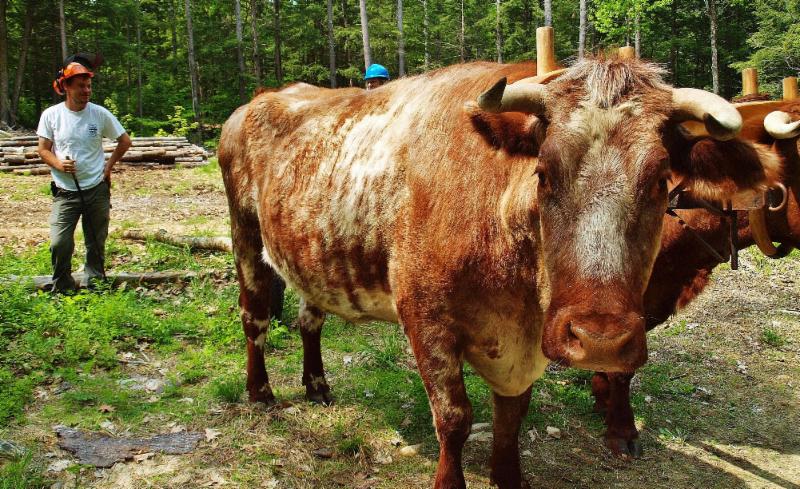
Space Still Available In These Workshops
Program Manager Molly Bolick reminds friends of Sanborn Mills Farm that there’s still space available in a few upcoming workshops, including:
Also, Save the Date — Sunday, July 28, 2019 — for Sanborn Mills Farm’s annual Open House!
Spiral Staircase Spins Toward Completion
The magnificent spiral staircase that has been gradually taking shape since last summer in Fifield Hall at Sanborn Mills Farm is finally near completion. The staircase is entirely hand-built, and will carry guests from the Hall’s first floor to the residence rooms on the second floor.
Kevin A. Schurman, the Farm’s infrastructure manager who has been overseeing the staircase project, says he spent a month just researching how to build the spiral and making it fit into a specific spot in the Hall. “When they were building these kind of staircases a hundred and two hundred years During his research he came across a book titled “Two Carpenters: Architecture and Building in Early New England, 1799-1859” that contained a wealth of valuable information, including information about building a spiral staircase, and got in touch with the author, J. Ritchie Garrison. “That was really helpful,” says Kevin, “because we wanted to do this right.” Kevin and his team built the staircase’s stringers, which create the spiral and support the risers and treads, by laminating several layers of wood that was routed and filled to facilitate the curve. The work was painstaking and took months — but in the end the spiral fit perfectly. Next, sheets of pre-cut veneer were glued to the stringers to provide a finished appearance (this was also difficult; the veneer had to fit exactly), and now the risers and treads are being attached. The final step is building the handrails, which Kevin says might be the most difficult element of all. “The curve has to match precisely,” he notes. “If you’re off even a little bit, like a sixty-fourth of an inch, it makes a difference.” Kevin and his team — carpenters Jake Farmer, Ray St. Pierre, and Scott Carbonneau — smile at the thought of future generations stepping up and down the wonderful staircase. “There’s just something about a spiral staircase,” says Kevin. “It’s both practical and art at the same time.”
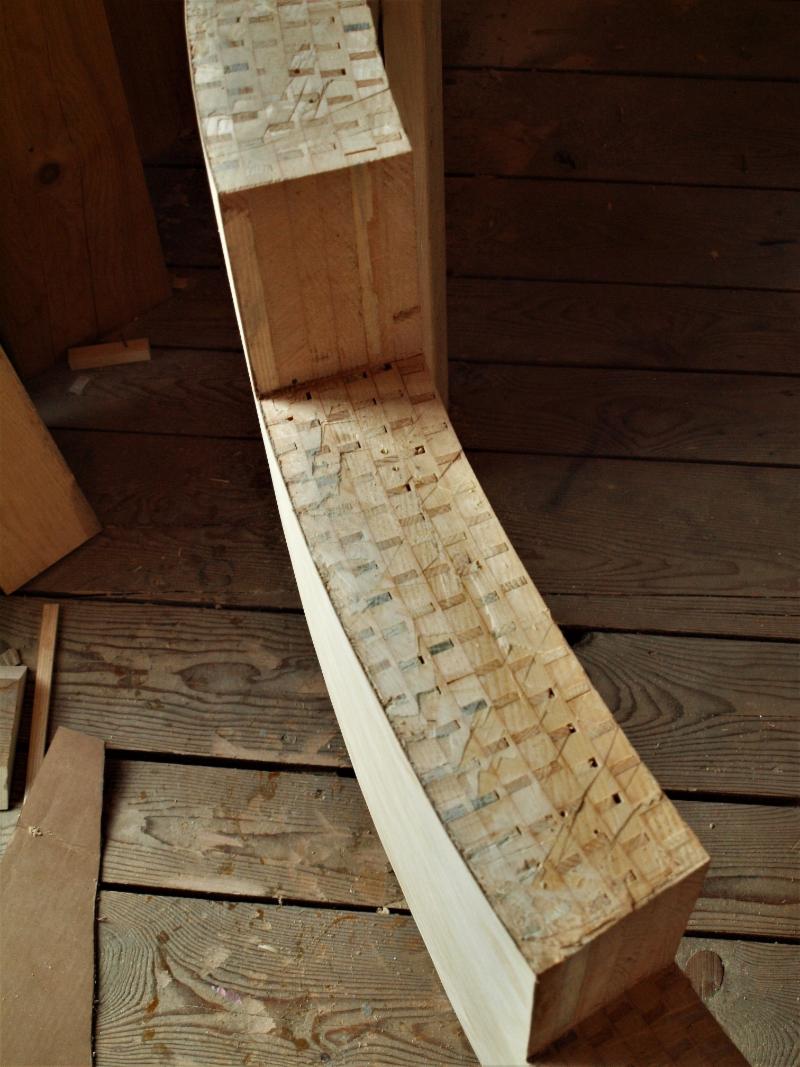
The staircase’s curve was created by laminating layers of wood that had been routed and then filled to make the curve possible.
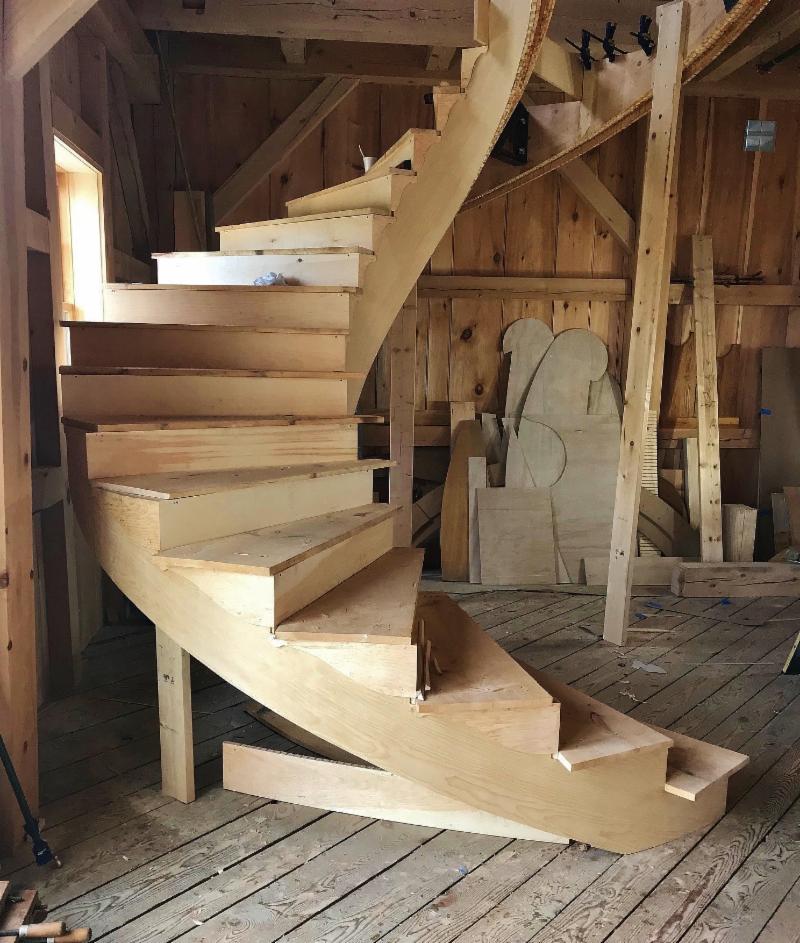
The last part of the staircase project — and the most difficult — will be adding the handrail.
Rug Hooking Workshop Teaches Traditional, Practical New England Craft
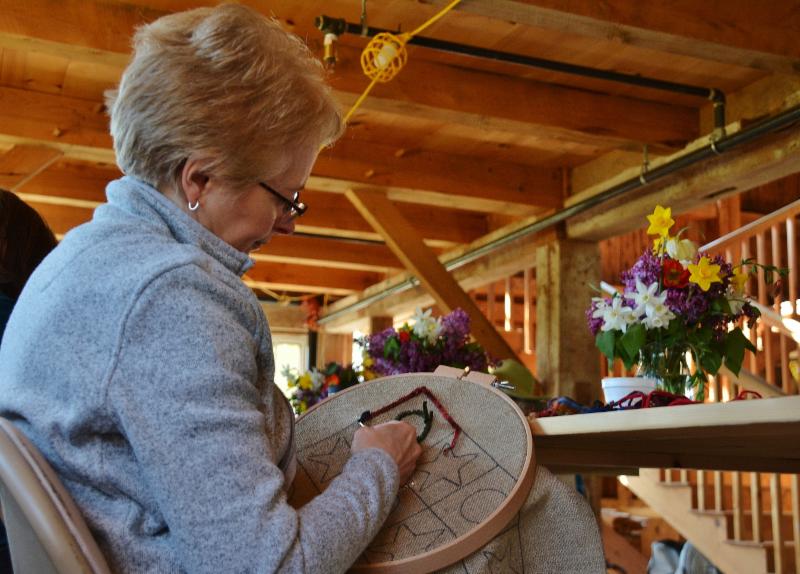
Rugs are made by threading — “hooking” — strips of fabric through a base such as burlap. Old grain bags were often used as the base in traditional rug-hooking.
Over a weekend in May at Sanborn Mills Farm, seven women, guided by instructor Pam Bartlett, learned the traditional and practical craft of rug-hooking. By the class’s finish, the students “had a good understanding of how to finish a hooking project,” says Pam, who has been rug-hooking for 30 years and for the past five years has owned and operated the Woolen Pear and Red Horse Rugs shop in North Loudon, N.H. The origins of rug-hooking may date back as far as the Vikings, who, it is thought, introduced a rough precursor to the craft to Scotland. In later centuries a form of rug-hooking developed in England. The modern version got established in the first half of the 19th century in New England and Canada’s Maritime provinces. “It’s a very utilitarian craft,” comments Pam, who notes that rug-hooking makes use of fabric scraps and things like old grain bags “to create something useful and even artistic for the home.” Wikipedia describes rug-hooking, in its early years, as “a craft of poverty.” Machine-made rugs became widely available after 1830 but were expensive; women who weren’t wealthy also wanted rugs — they helped give warmth to homes during New England’s frigid winters — and used whatever materials they had available. Pam points out that not just women were rug-hookers. “Sailors did it too.” Today, rug-hooking is acknowledged as an artistic craft, not just a utilitarian effort, and in fact rug-hooking was one of the first traditional New England crafts to be exhibited, in 1926, at Sandwich Home Industries (now called the Center Sandwich Fine Craft Gallery), which was a founding member of the League of New Hampshire Craftsmen. “I’ve always like traditional crafts,” says Pam. “And this is so practical, yet you can make something quite beautiful at the same time.”
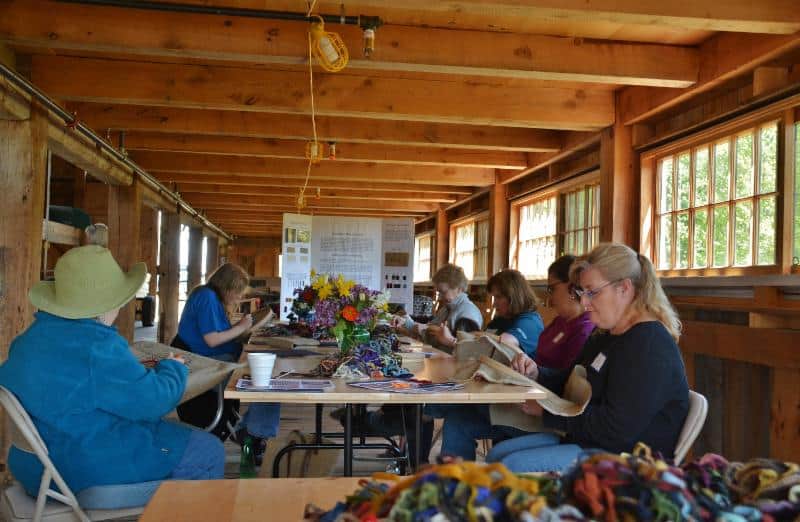
Students hook and chat around the hooking table at the Rug-Hooking Workshop.
Student Woodturning Competition a Big Success at Sanborn Mills Farm 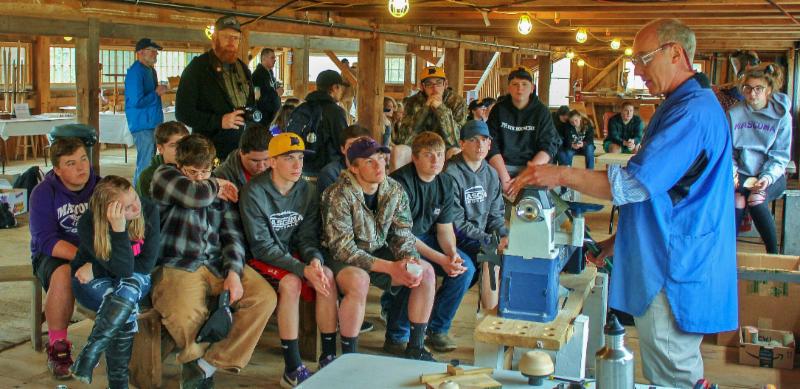
Students learn the fine points of turning wood on a lathe during the competition’s workshop.
The Guild of New Hampshire Woodworkers hosted its annual Student Woodturning Competition at the Farm on May 17, bringing together 60 students with 83 entries to compete in categories ranging from bowls and Students came from four different schools, including Mascoma Regional High School, Merrimack High School, Thetford Academy, and Manchester Memorial High School. Photo entries came from Lincoln-Sudbury Regional High School
“
Judges included Marcel Durette, Charles Scheaf and Claude Dupuis, who Dr. Pennucci says were often hard pressed to choose just the very best. In their critique, both Marcel and Charlie emphasized form, proportion, balance and curvature of line. “Speaking in defense of simplicity, the axiom ‘less is more” made all the difference in choosing top notch work and we applaud these many students for the time and the excellence that resulted in these terrific projects,” she adds. Next year’s competition is already scheduled to take place at the Farm in mid-May. Winners of the 2019 Guild of New Hampshire Woodworkers Student Woodturning Competition include: Miniatures: 1. Emily Pierce, Merrimack 2. Meredith Sousa, Mascoma 3. Cole Keefe, Merrimack 4. Caleb McCalister, Mascoma 5. Melissa Medeiros, Merrimack Hollow Forms: 1. Matt St. Laurent, Merrimack 2. Nathan Livie, Merrimack 3. Austin Churchill, Mascoma 4. Justin Mason, Mascoma Platters: 1. Brittney Lowell, Mascoma 2. Blake Corbin, Mascoma 3. Ethan Gelinas, Mascoma 4. Josh Williams, Mascoma 5. Olivia Clifford, Mascoma Bowls: 1. Liam Rinelli, Thetford 2. Nathan Livie, Merrimack 3. Nathanial Rinelli, Thetford 4. Logan Brinkman, Thetford 5. Matt St. Laurent, Merrimack Spindle: 1. Wesley Bolling, Merrimack 2. Aidan Cudhea, Thetford 3. Alex Emerson, Thetford 4. Torrie Howlett, Mascoma 5. Ava Lambert, Manchester Stools: 1. Asa Wood, Mascoma 2. Caleb Drexler, Mascoma 3. Ryan Crate, Mascoma 4. Elyas Jenkins, Mascoma 5. Hagen Jandrue, Mascoma Segmented: 1. Lindsay Houston, Mascoma 2. Paige Jette, Mascoma 3. Caleb McCalister, Mascoma 4. Brooks Bernier, Mascoma 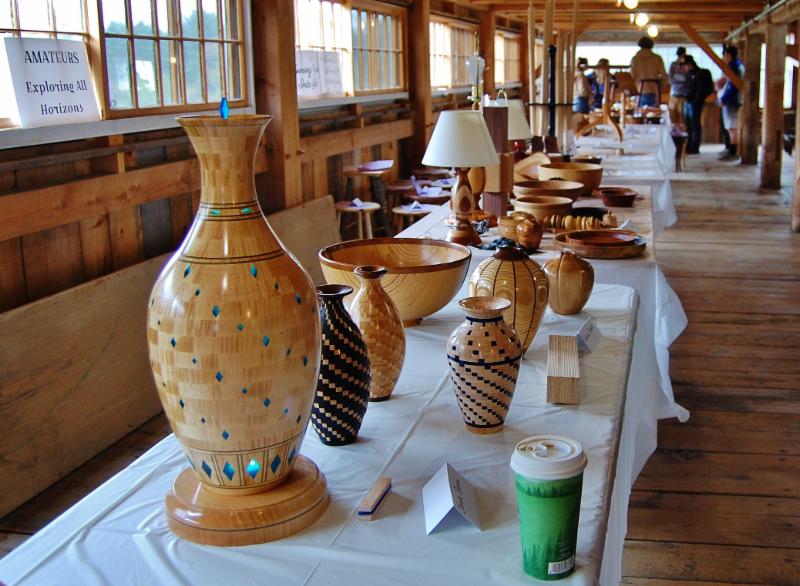
A sampling of the fine woodwork crafted by N.H. high school students for the Student Woodturning Competition held in May at Sanborn Mills Farm.
Photo Credits
Rug-hooking photos by Molly Bulick. Woodturning competition photos by Jim Seroskie (top) and Annamarie Pennucci (bottom).
All other photos by Steve Bjerklie.
The last part of the staircase project — and the most difficult — will be adding the handrail.
Sanborn Mills Inc. | 603-435-7314 |
A traditional New Hampshire farm and nonprofit organization dedicated to sustainability, creativity, and preserving folklife skills and agricultural knowledge so that the best of the past can help shape our future.
The last part of the staircase project — and the most difficult — will be adding the handrail.
STAY CONNECTED: 


The last part of the staircase project — and the most difficult — will be adding the handrail. |
|