
SHARE:

 |
At Sanborn Mills Farm, preserving the past and planning for the future go hand in hand!
July 2018 eNews
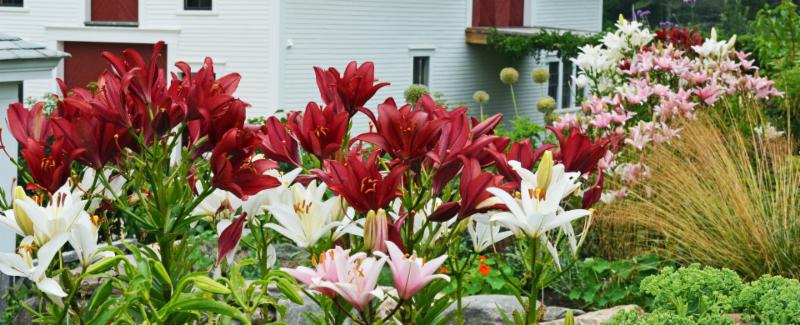
Our annual Open House is Sunday, July 29!
Come visit us for our annual You can take a self-guided tour of the grounds and there will be demonstrations of blacksmithing, draft animal work, flax processing, ox yoke making, and traditional woodworking. The water-powered grist mill and saw mill will be running, unless of course we are short of water. There may even be a chance to purchase fresh farm produce, eggs, and maple syrup. Feel free to bring a picnic lunch & spend the day!
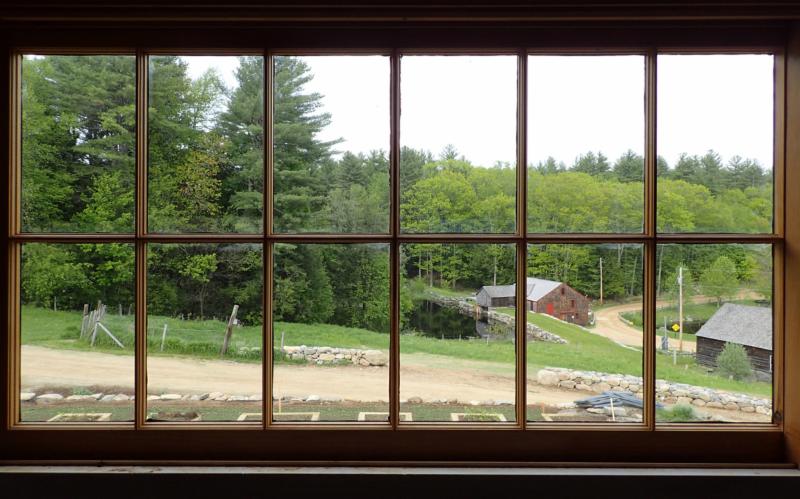
Admission is free and no reservation is needed. However, donations to support our educational programs gratefully accepted. Some buildings are under construction so each child under the age of 12 must be accompanied by an adult.
Click here to download & print out a brochure with a map of the farm before you come! If you can’t make the Open House, please keep in mind that the farm is not open for visitors on a daily basis. However, group tours can be scheduled from spring through fall. Click here for more information on how to arrange a tour.
Snapshots from workshops . . It has been a busy summer so far with workshops full of people getting things done! Here’s a peak at what they’ve been up to.
Blacksmithing The knife is one of the most basic of human tools and guest instructor Lucian Avery of Hardwick, Vermont taught our first ever knife making workshop this past April. Students spent the first day drawing out the tang and the blade for a small carving knife. Lucian had them file the beveled knife edge by hand and then moved on to showing them how to heat treat and temper the blade. The next step was to set the tang in a wooden handle and carve it to a comfortable shape. On the second day they made a custom sheath out of goat hide. On the third day students whittled a wooden butter knife and spoon with the knife they made! 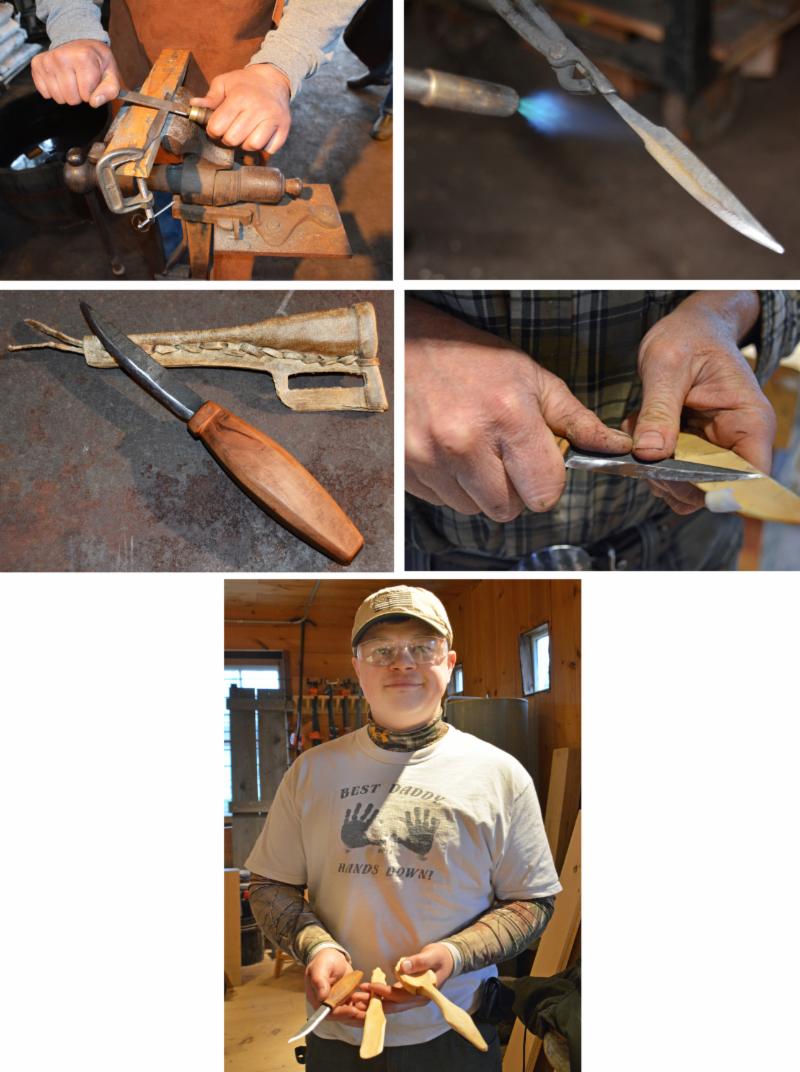
Left to right, top to bottom: Hand filing the bevel; heat tempering the blade; finished carving knife with sheath; whittling a butter knife; and Matthew Herrick of Henniker, NH with his completed carving knife, wooden butter knife and spoon. Oxen According to Alexander Langlands in his book Craeft – An Inquiry into the Origins and True Meaning of Traditional Crafts, “While the earliest depictions of oxen . . come from the Upper Nile of the fourth century BC, archaeological evidence suggests that oxen had been domesticated to work the land as early as the seventh century B.C.. Oxen then continued as the ideal draught animal for the next eight thousand years, with donkeys, mules and in some places goats used to a lesser extent.”
The skills of working with oxen continue to be an important part of New England’s heritage and are shared through the 4-H Working Steers program and workshops at Sanborn Mills Farm. This June, seven people participated in the 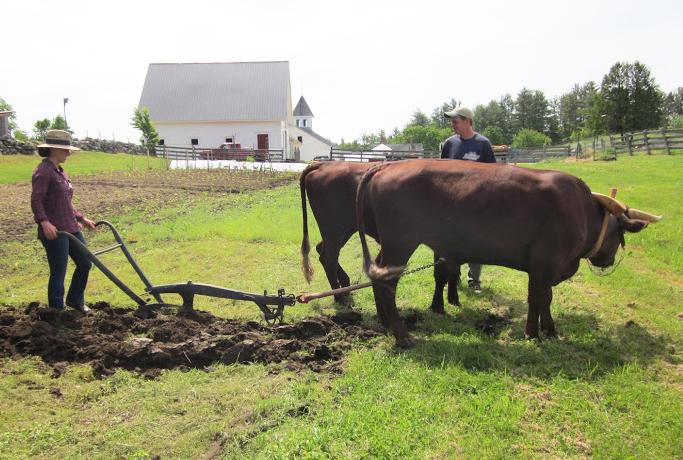
Elsa Acerbo of Riverhead, NY plowing in the Teaching Garden with instructor Tyler Allen driving Ruff & Tuff, a team of Devons.
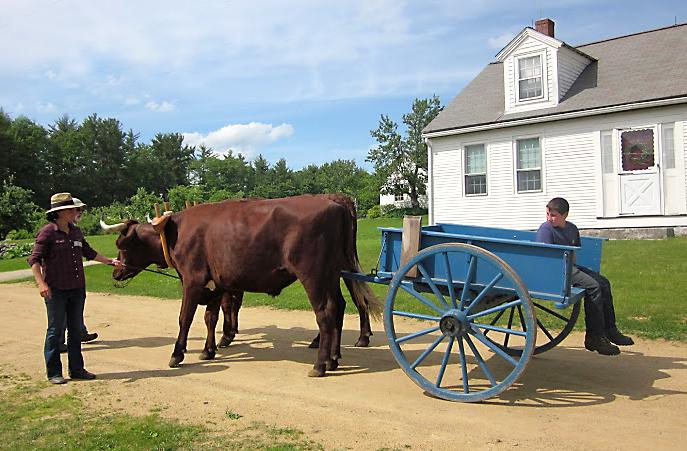
Elsa Acerbo and Durham team Huck and Finn returning from a morning of work at Joe’s farm with Luke Bronnenberg riding on the ox cart.
Baskets Up until modern measuring systems and containers became common, baskets were a form of measurement for produce – bushel, half bushel, peck and half peck being the most common. Whether made from strips of wood, bark, dried grasses, reeds, branches, or vines, the goal is to find a material that can be bent, twisted, or plaited to create a form. This summer Wendy Jensen from Monterey, MA taught a fast paced one-day workshop using rattan reed. Working steadily through the day, everyone went home with a practical and beautiful round field basket. 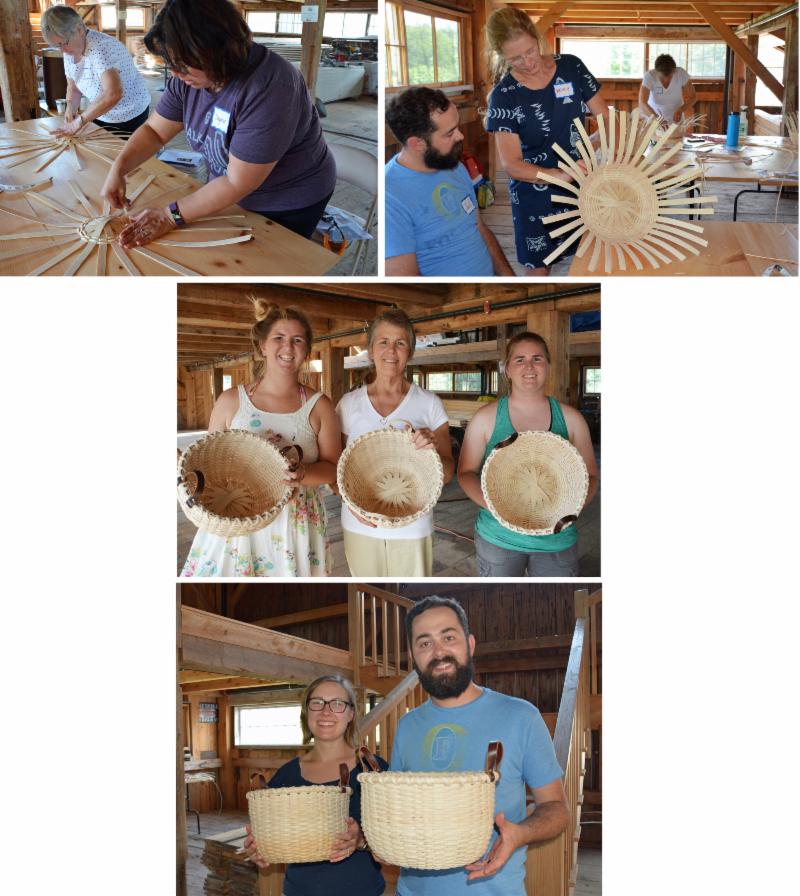
Left to right, top to bottom: Jean Therrien of Gilford (left), NH & Dagmar Sepulveda of Henniker NH starting their round basket; Jack Swanson of Weare, NH taking tips from instructor Wendy Jensen; the Woodward family (Lucy, Hillary & Emma) with their finished baskets; and Molly & Jack Swanson with their completed baskets.
Floor Cloths Before braided and hooked rugs grew into common use on New England floors, people used what were sometimes called “crumb cloths” or “oyled cloths.” They were very popular in Colonial times and records indicate they were used in the homes of our founding fathers including Thomas Jefferson and George Washington. The process started with a piece of painted canvas (sometimes portions of worn out canvas sails). The designs were usually stenciled and in some cases made to imitate more expensive marble tiled flooring. The surface was coated with layers of linseed oil to make it waterproof and strong. Floor cloths remained a common floor covering until the development of linoleum around the turn of the century. Here’s an excerpt from an advertisement in the New Hampshire Gazette of 1828.* “These carpets possess a decided advantage over all others, as they are more durable, and in warm weather much more comfortable, and easier to keep clean, and in hot climates the only kind that are not subject to injury from insects; in winter they may be covered with other carpeting without damage, and the room is kept warmer …”
Michele Hollick of Hollis, NH is a juried member of the 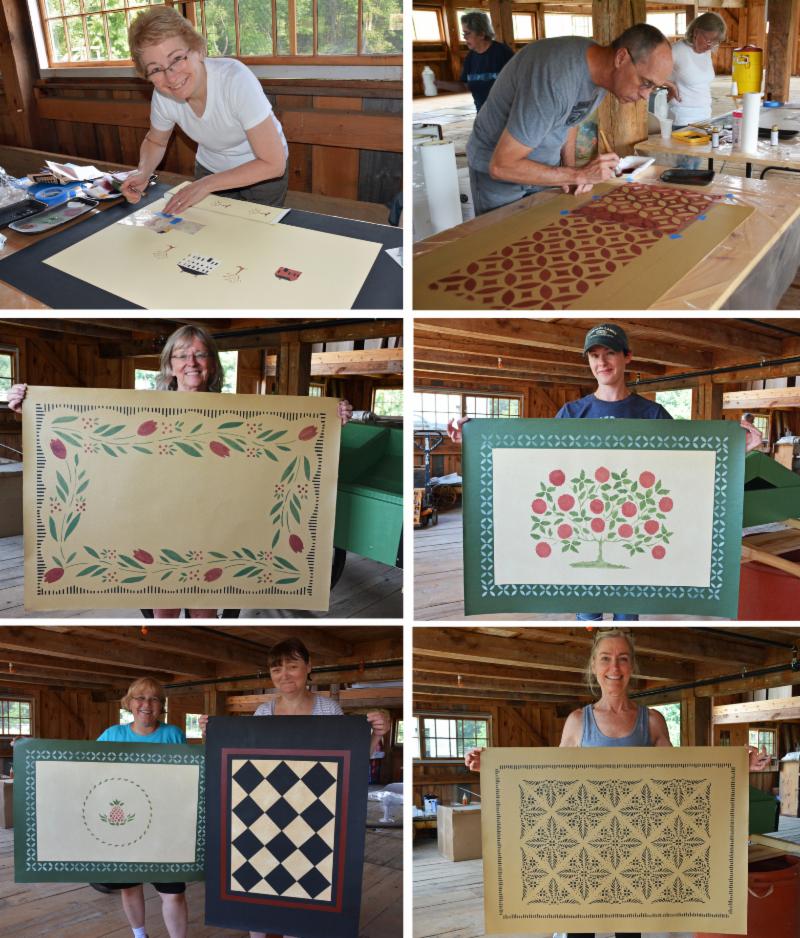
Left to right, top to bottom: Heather Diamond of Londonderry, NH stenciling a Rufus Porter design; Joe Lahr of Hummelstown, PA stenciling an Isaac Buck House design; Joe’s wife Denise with her Wayside Inn floor cloth; Sharon Warga of Plymouth, NH with her Shaker Tree floor cloth; Bonnie Mohla (left) of Wilder, VT with a pineapple design & Claire Gendron of Center Barnstead, NH with her diamond design; and Martha Forgione of Woodstock, VT with her Edward Durant House piece.
The charm of antique roses . . . 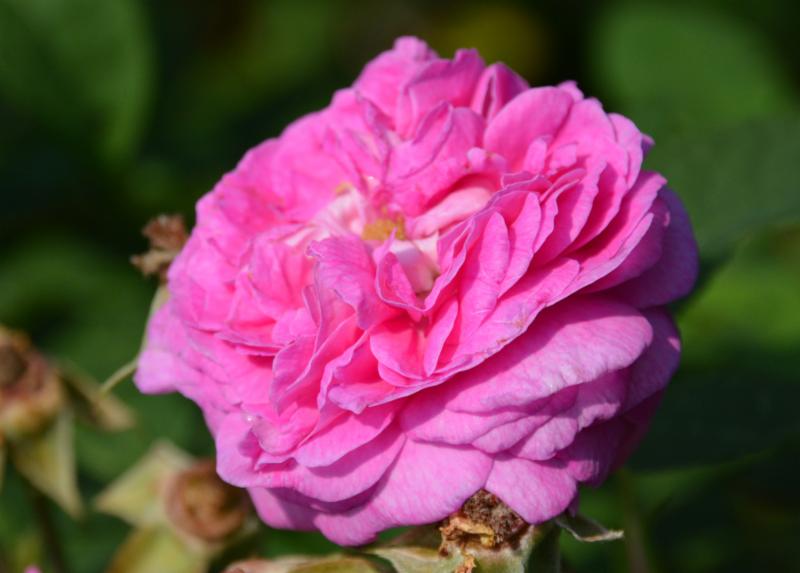
Antique Roses by Robert Sieczkiewicz
Stepping into the room it is soon felt
A sweetness supplied by the month of June Triggering memories when rose is smelt Rose under the nose could cause one to swoon.
The rose has a fragrance as no other
Soon June will give way to the summer heat
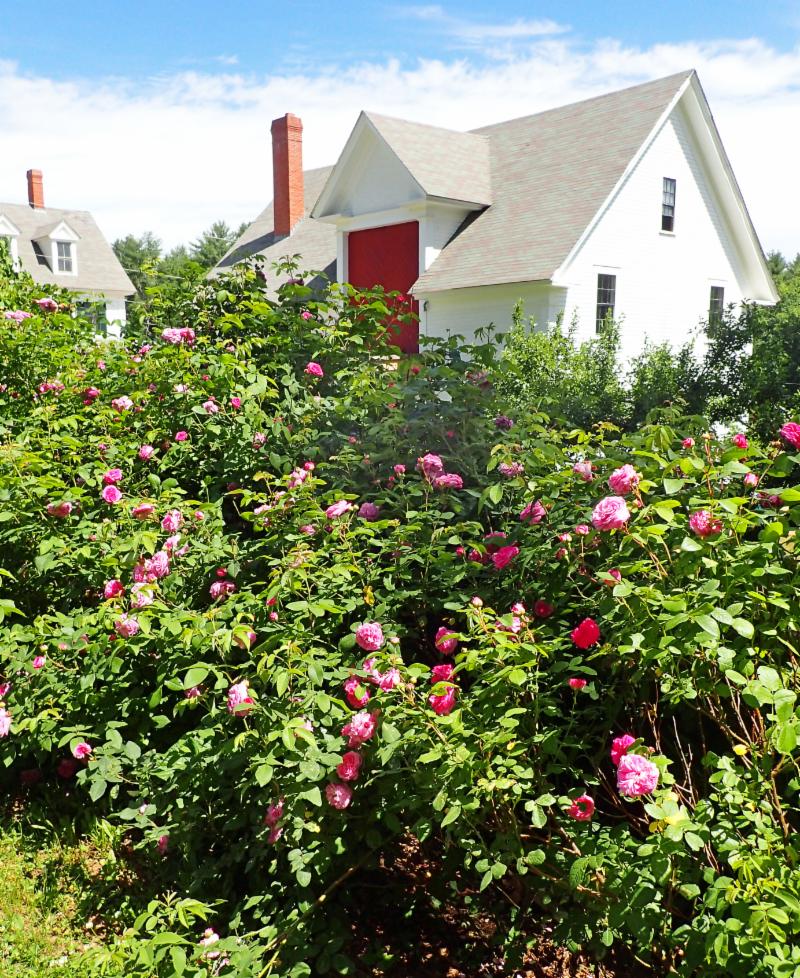
No one to see that perfect rose I took Growing roses in the Northeast where winters are long and cold can be challenging. The trick is to find a rose that will endure. While there are 150 species of roses, there are thousands of varieties. Roses are generally grouped into three categories – wild roses (those that have been growing wild for hundreds of years); old garden, heirloom or antique roses (those that that existed before 1867), and modern garden roses (those that have been developed since 1867).
We have an especially hardy and prolific antique rose at Sanborn Mills that is at least 100 years old. From our research, we believe it is Rosa centifolia “Petite Lisette” named for the blossom’s hundred petals. The story goes that it was first raised in the Netherlands in the 17th century and that it was a favorite of Marie Antoinette’s. Like many antique roses, ours blooms once a year, usually in June and the blossoms are extremely fragrant. As the season progresses, the blossoms give way to rose hips, a traditional and abundant source of Vitamin C. If you are looking for an easy to care plant for your garden – hardy & resistant to disease and insects, search around for an heirloom rose and you will not be disappointed. And just think of the many ways you can use those fragrant rose petals? Click here for some ideas. “You can complain because roses have thorns, or you can rejoice because thorns have roses.”
More on roses:
The Ox Corner by Tim Huppe
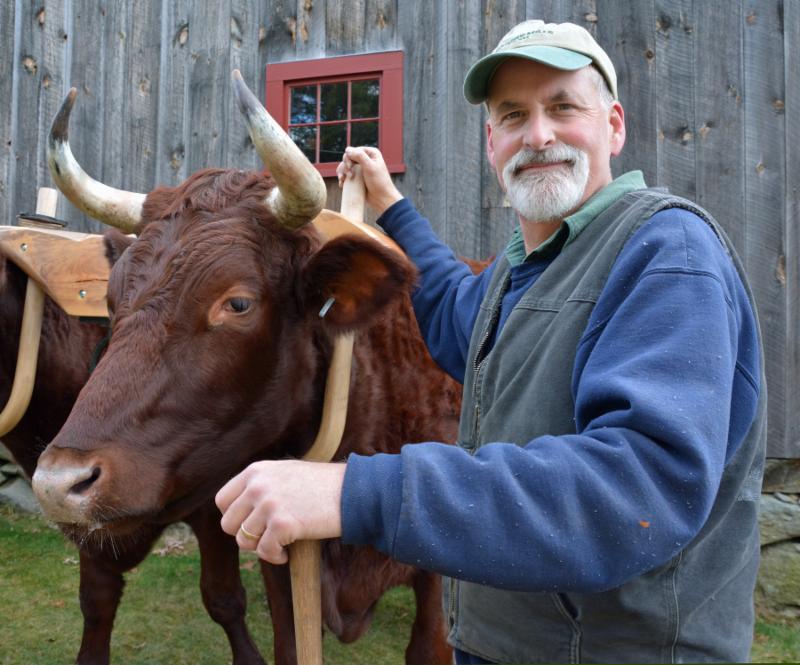
Every ox teamster has a list of famous oxen fixed in their memory. One such team for me was Les Barden’s Durham oxen, Cy and Don.
Click here to read more about Cy & Don. This month’s Ox Corner also includes a list of resource books on oxen.
Credits for photos & quotes:
Oxen workshop images courtesy of Elsa Acerbo of Riverhead, NY. All other images by Lynn Martin Graton. Floor cloth quote – http://www.kathycooperfloorcloths.com/what.html Poem “My Search for Beauty” – https://mysearchforbeauty.blog/2018/04/28/antique-roses-a-poem-by-robert-a-sieczkiewicz/ Alexander Langland quote from his book Craeft – https://www.amazon.com/default/e/B077QFDJV3?redirectedFromKindleDbs=true Ziggy quote on Roses – – http://www.wiseoldsayings.com/roses-quotes/
Sanborn Mills Inc. | 603-435-7314 |
A traditional New Hampshire farm and nonprofit organization dedicated to sustainability, creativity, and preserving folklife skills and agricultural knowledge so that the best of the past can help shape our future.
STAY CONNECTED: 


|
|