
SHARE:

 |
At Sanborn Mills Farm, preserving the past and planning for the future go hand in hand!
Early June 2018 eNews
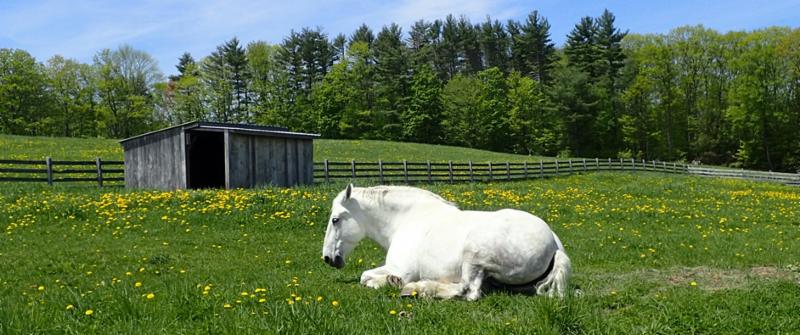
Spring Planting . . . We started growing carrots in the hoop house in Feburary and other seeds were planted in April. Our efforts have already yielded results including carrots, lettuce, spinach, and radishes for our May workshops. 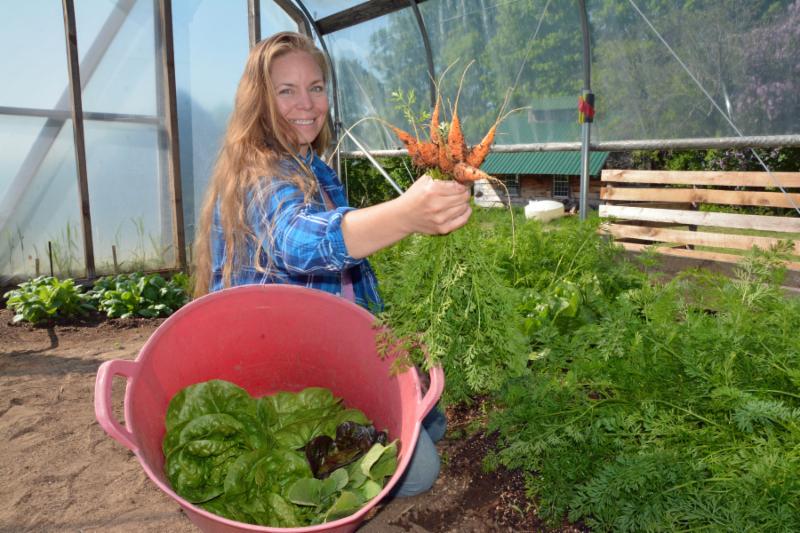
Gardener Jenn Merrill with a handful of new carrots and a bucket of spring lettuce for our upcoming workshops.
As we move out to planting vegetables in the gardens, this season we are emphasizing companion planting because as it turns out, certain vegetables grow better when planted next certain others. Success in companion planting has a lot to do with knowing which nutrients a plant draws from or leaves in the soil. As part of our companion planting strategy, we are integrating flowers throughout the gardens. Flowers can attract much needed pollinating insects, confuse insects that are harmful to vegetables, and attract beneficial insect predators. Some flowers even minimize viral and bacterial infections in the garden.
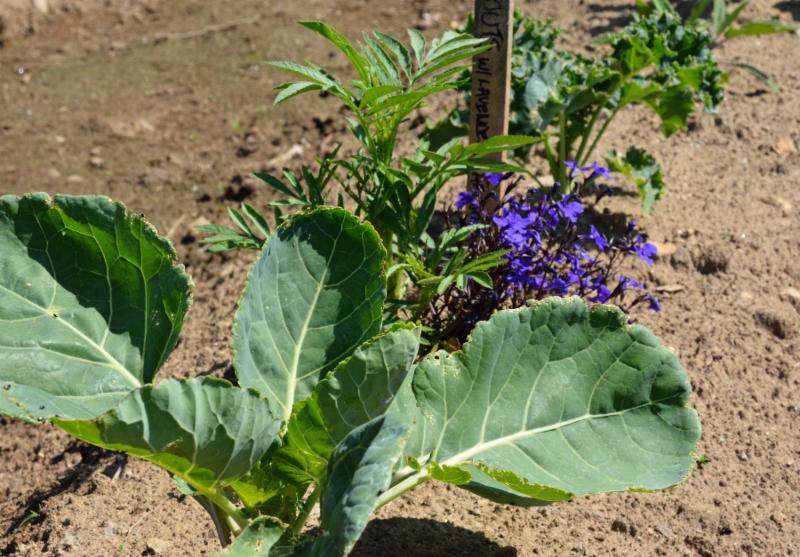
Our current flower helpers include petunias, alyssum, lobelia, marigolds, and nasturtiums. We are also planting a hedge with highly fragrant plants that deer don’t particularly like including scented geranium, dill, rosemary, sage, catnip, and lavender.
In the big fields, Farm Educator Ray Ramsey, along with teamsters John Schlang and Tyler Allen, put a newly repaired antique corn planter to work planting field corn that will be ground in our water-powered grist mill for livestock feed. We are diversifying field crops this year so the team planted Streaker oats and Golden flax as well.
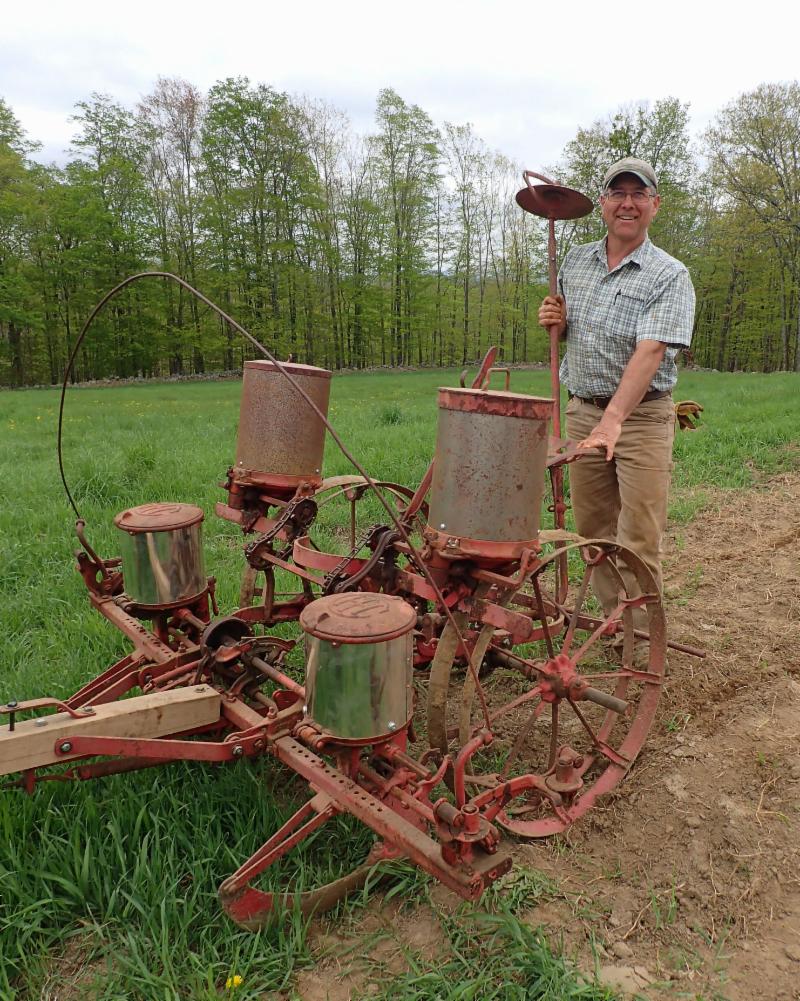
Ray with the newly restored early 20th century corn planter. 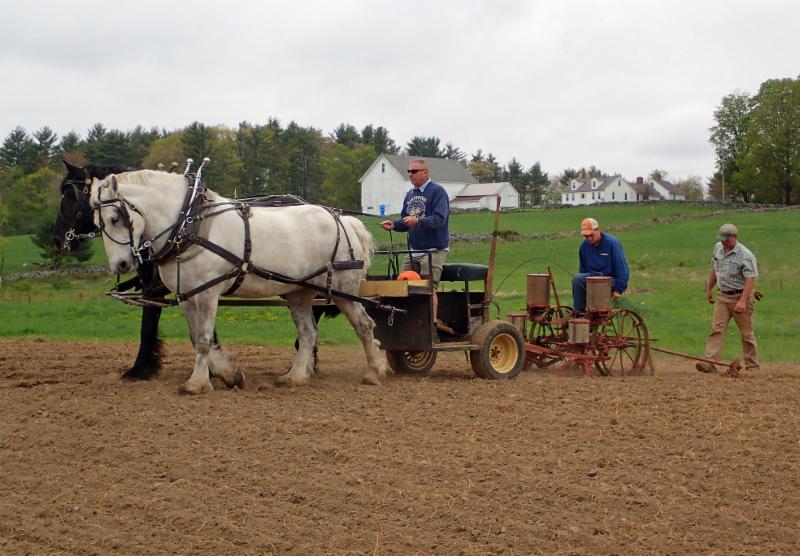
John driving Willie & Rose, Tyler on the corn planter, and Ray making sure it’s all working correctly!
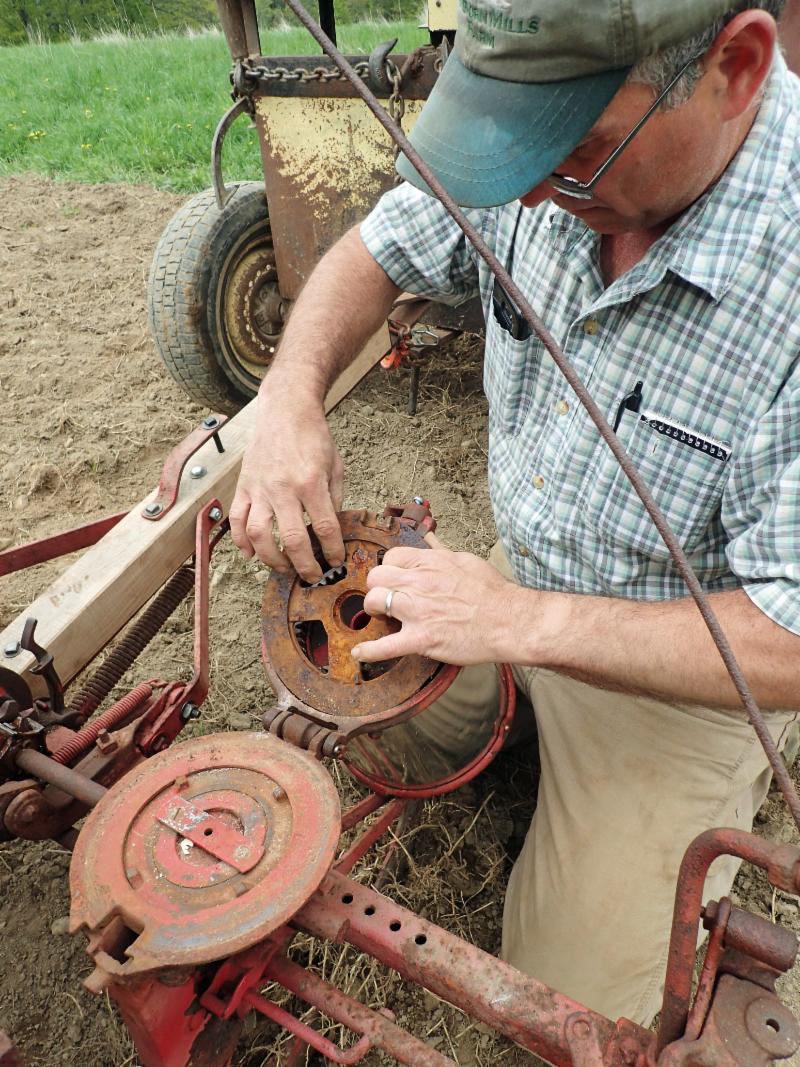
All old equipment needs frequent adjusting. Here Ray is checking the disc that governs the rate of corn kernel drop.
As part of our goal to grow the materials needed for making traditional crafts – what we are calling “stump-to-stick” – we started a Sally Garden in May. We ordered seven varieties of willow from our New England neighbors at Vermont Willow Nursery. In a few years we will be able to coppice willow rods in a range of colors every year.
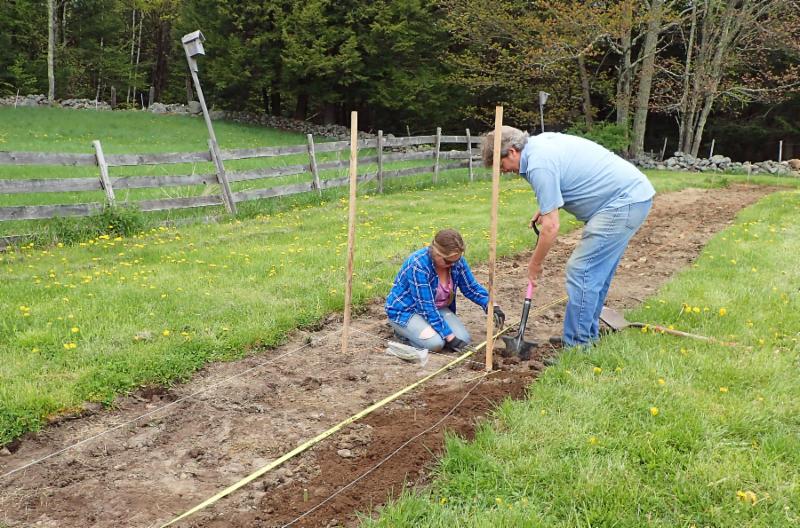
Colin Cabot & Jenn Merrill planted over 120 willow cuttings in a newly cleared area at the far edge of the Teaching Garden.
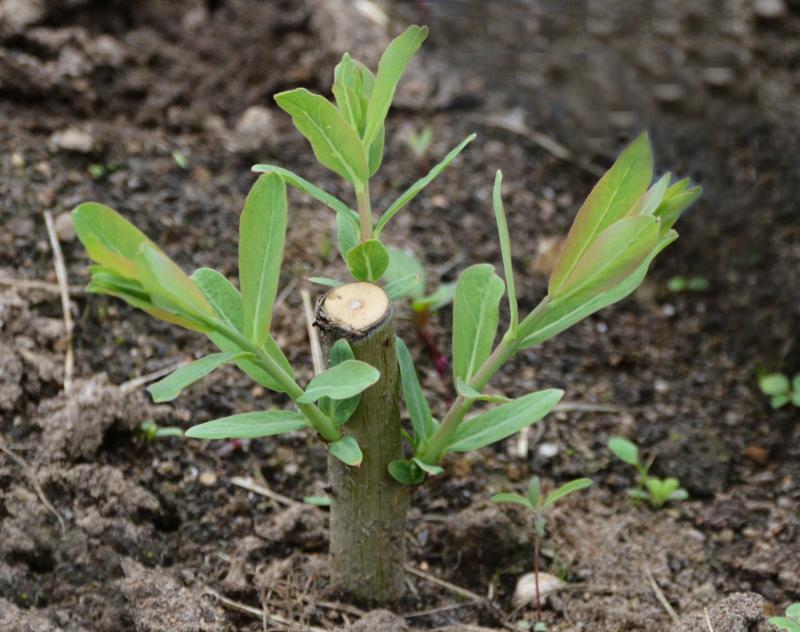
All you need is a 10″ cutting with just a couple inches above the soil to start a willow plant!
More information on companion planting: More on basketry willow:
Spring also means high water & time to saw . . . 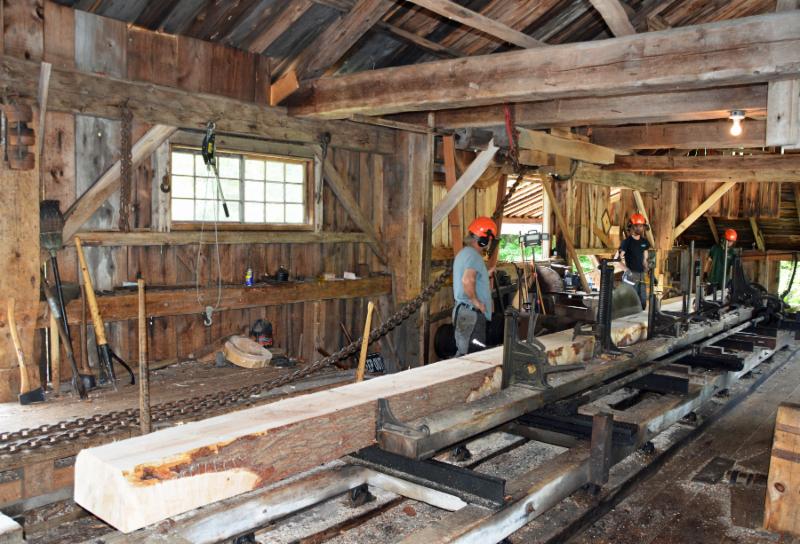
Our mill has a carriage that can saw a timber up to 40 feet in length. This one is nearly 36 feet long!
We’ve been sawing out timbers this spring for a new barn. Large logs have been arriving from a variety of sources, including our own woods where forester Jake Bronnenburg has been salvaging trees that were downed in last year’s catastrophic storm. 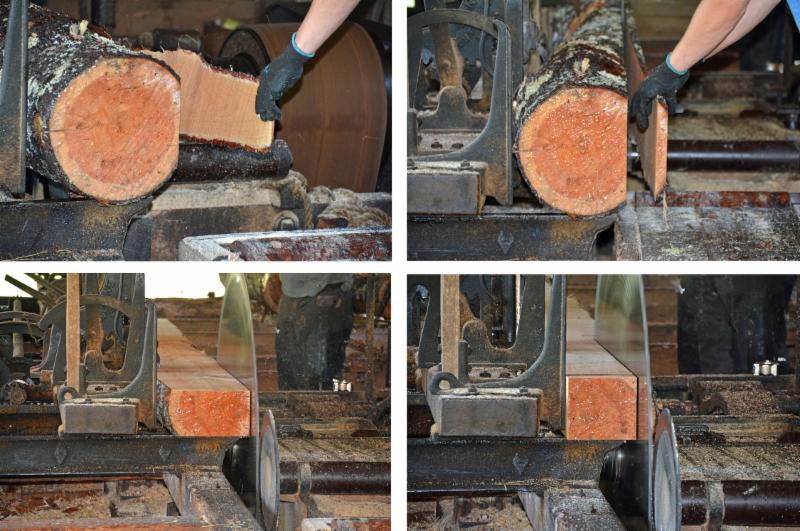
Sawing a timber starts with cutting off the outer bark. The resulting piece is known as a slab. The log is then rotated and cut on all four sides to get the dimensions needed.
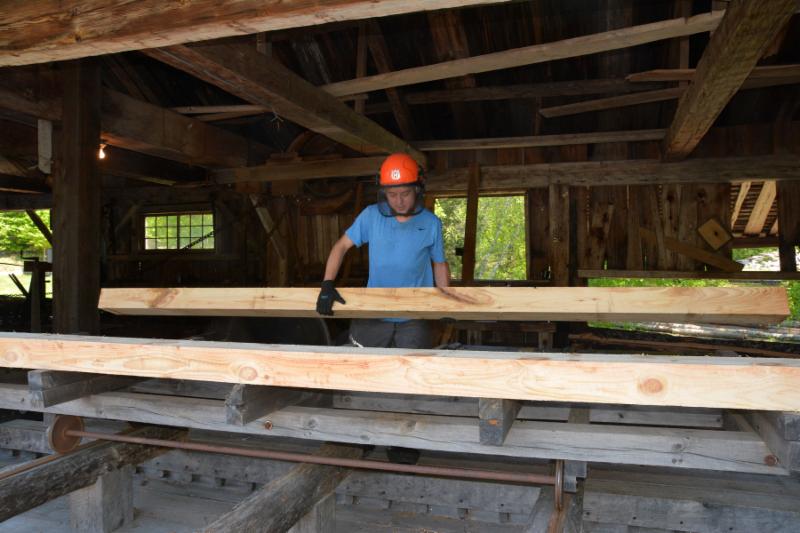
Millwright assistant Logan Clough stacking up newly sawed timbers that will be used for purlins or floor joints.
Building Traditional Windows . . .
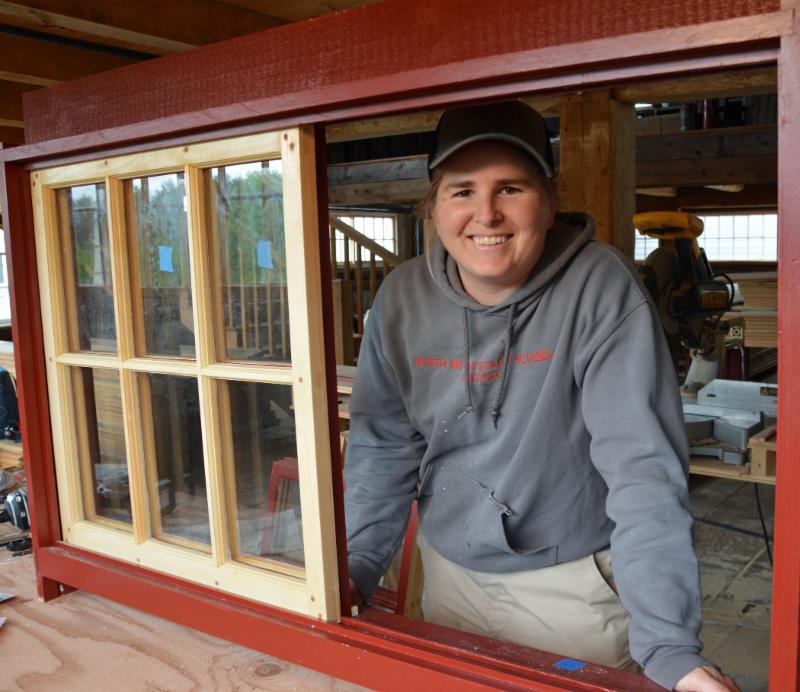
People have long sought a way to let air and light into a house and keep bad weather out. The story goes that the earliest window openings were covered with animal skins. Medieval windows were sometimes made of panes of flattened animal horn or thinly cut stone like marble or alabaster held in a wooden frame. In Asia they often used paper. In Europe, glass windows did not become common in ordinary homes until the early 17th century. Today, glass windows are commonplace and most often ordered from a window manufacturer or big box store. However, at Sanborn Mills Farm we are preserving the skills needed to make true divided light sash windows – a style first introduced to the British colonies just after 1700. The renovation of a farm out-building we call “The Turkey Palace” into a space for making draft animal equipment gave carpenter Emma Woodward an opportunity to use the skills she learned at North Bennett Street School. According to James Garvin in his book – A Building History of Northern New England, ” a window sash is one of the most delicate and complex building components made by the joiner.”
A sash is a movable frame that holds panes of glass. The outer frame consists of horizontal bars (called rails) and vertical bars (called stiles) connected at the corners with carefully cut mortise & tenon joints and secured with wooden pegs or wedges. The sash is divided into sections by vertical and horizontal dividers called glazing bars or muntins, which are sometimes confused with the term mullions.
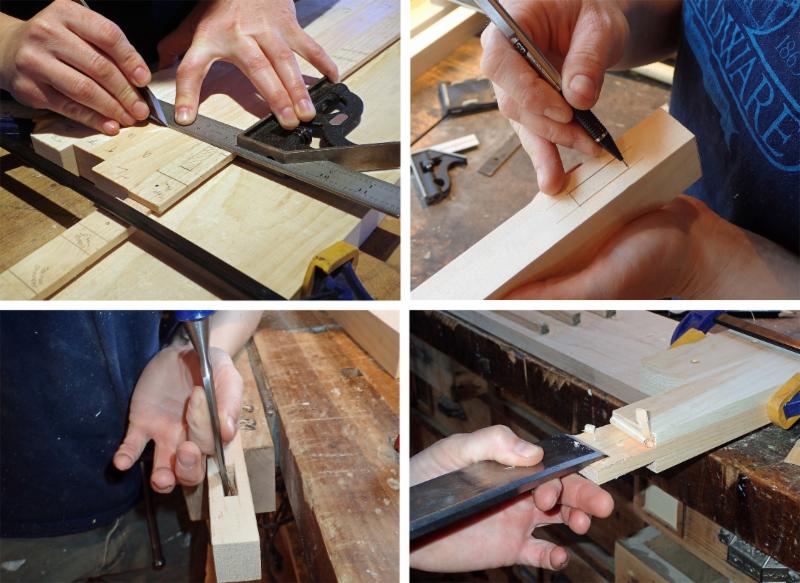
Clockwise from upper left: scribing the location for mortises & tenons using the story stick; outlining the mortise; cutting the mortise; and cutting the tenon.
The process begins with laying out a “story stick” that indicates exactly where to cut the mortise and tenon joinery identically for each rail and stile. While some sash windows have horizontal muntins that are separate pieces fitted into the vertical muntins, carpenter Kevin A. Schurman shared a method with Emma where both the vertical and horizontal muntins go the length of the sash and notch together where they intersect, making for – in our opinion – a very strong window that can better withstand the temperature shifts in Northern New England.
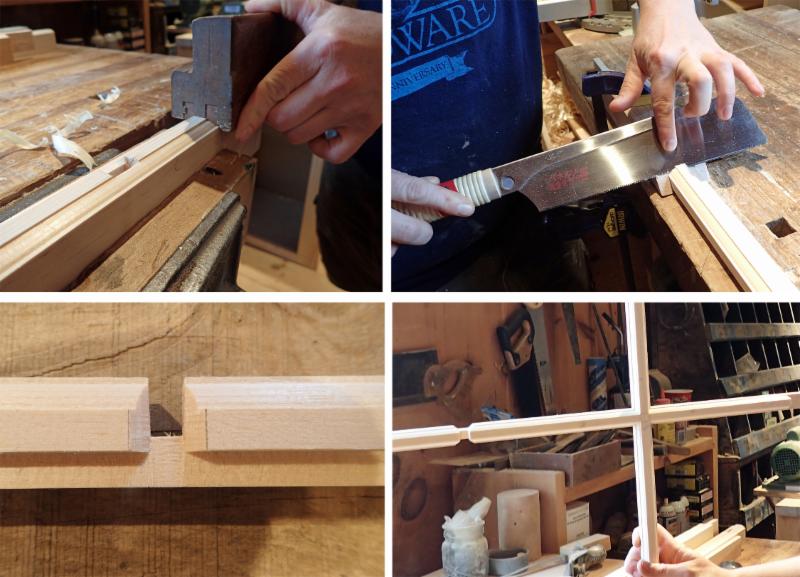
Clockwise from upper left: planing the profile of the rail with an antique sash plane; cutting the notch where the muntins will intersect; a completed beveled notch; and the first muntin connection on a six light window.
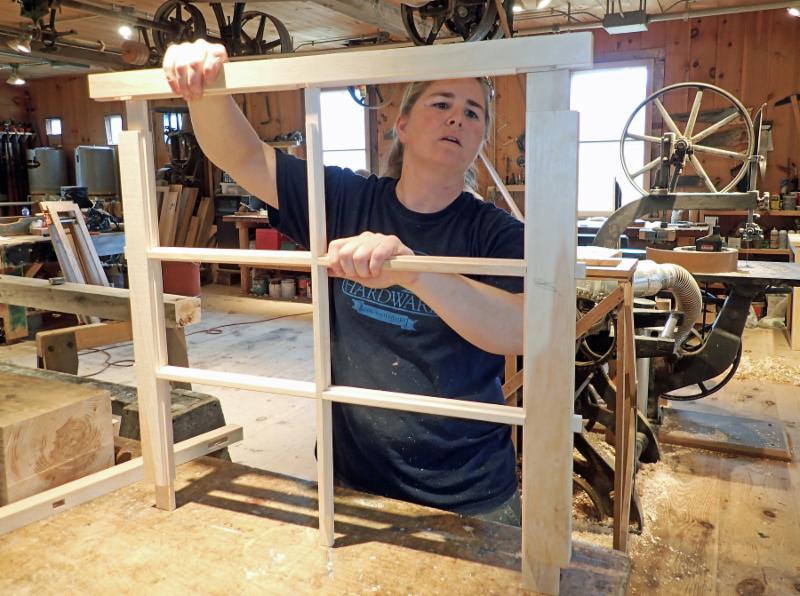
Emma assembling the sash. The last step is to set the glass panes into the finished openings with putty, a process called glazing. Emma used oil based glazing compound as it retains a little flexibility, important as the window expands and contracts through the shift in seasons.
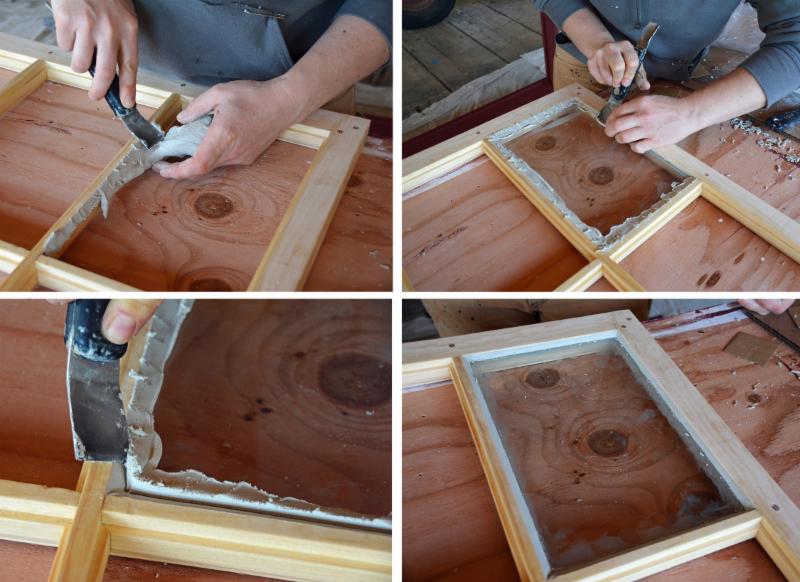
Steps in glazing from upper left: applying the initial layer of glaze putty is called bedding the glass; applying a top layer of glazing putty after setting the glass in place; cutting a clean bevel around the glass and removing excess putty (not shown is removing the excess putty from under the glass); and finally the glazed pane. The process of making a window sash requires careful planning, precise cutting, and frequent cross-checking to make sure all sections are square and true. One little error along the way and a window won’t open smoothly or the glazing putty could fail. We are happy to report that Emma did a wonderful job every step of the way! 
M
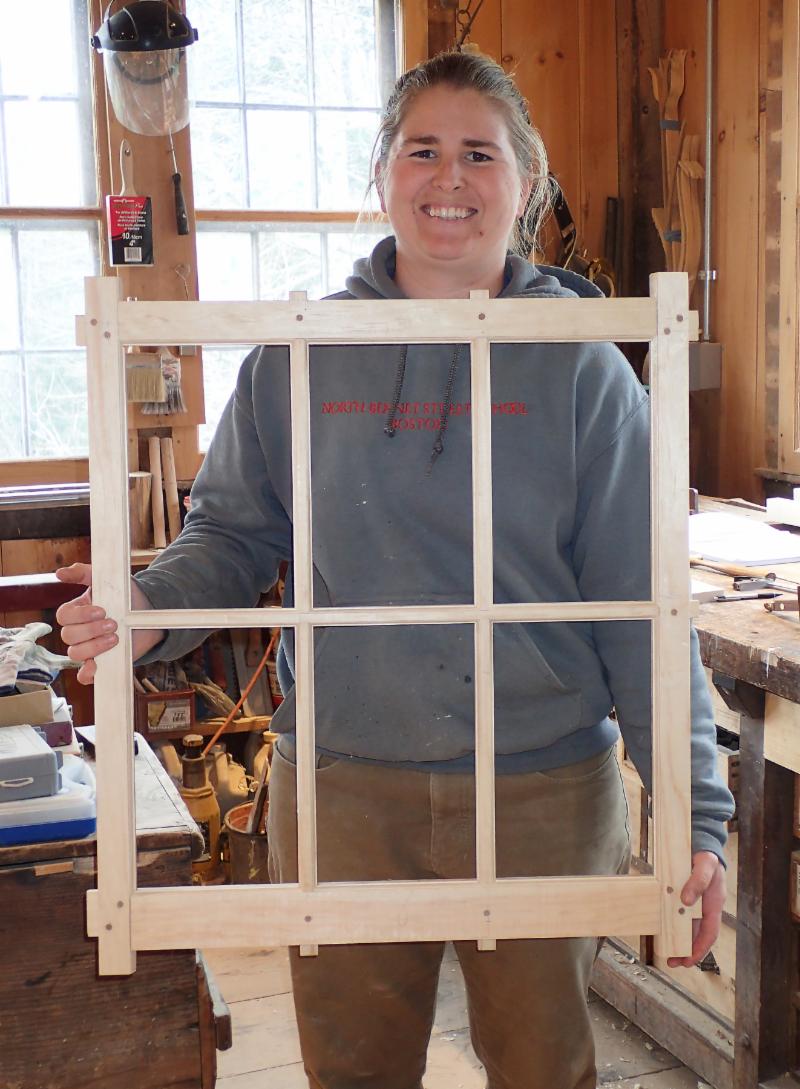
Emma with an assembled frame. The extra length on the stiles (called “horns”) will be trimmed off before setting the sash in the window frame.
The Ox Corner by Tim Huppe
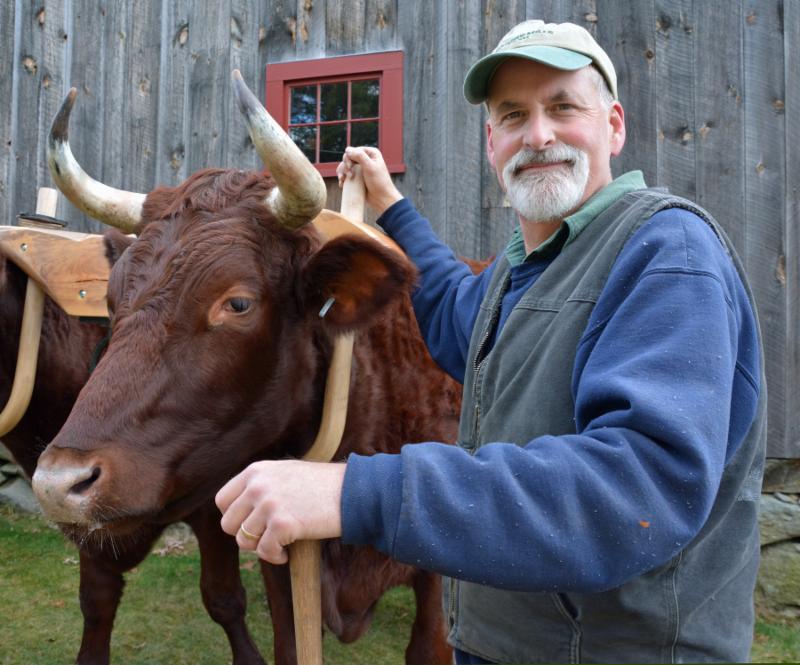
I am happy to introduce to our readers, The Ox Corner. Included in each month’s eNews will be information that pertains to the care, the training, and the use of oxen. And occasionally, I will be sharing stories of my experiences using oxen, stories of teamsters and teams from my past, and of those which came before. I invite you to read a piece I recently wrote, “ I grew up on a small family farm in Farmington .” Click here for this month’s Ox Corner, which will get you started with some important basic vocabulary on working with oxen.
How to visit the farm
The best time to see the farm is during the annual
The farm is not open for visitors on a daily basis, but group tours can be scheduled from spring to fall.
Photo Credits:
All images by Lynn Martin Graton.
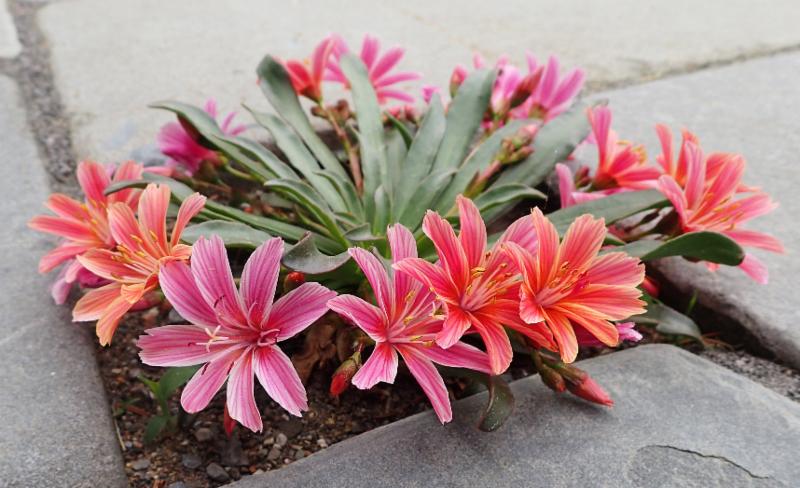
Lewisia Cotyledon var. Heckneri, a rare perennial Alpine plant we obtained from Stonecrop Gardens and that is named after the explorer Meriwether Lewis who first encountered it in 1806 in the upper Northwest.
Emma with an assembled frame. The extra length on the stiles (called “horns”) will be trimmed off before setting the sash in the window frame.
Lewisia Cotyledon var. Heckneri, a rare perennial Alpine plant we obtained from Stonecrop Gardens and that is named after the explorer Meriwether Lewis who first encountered it in 1806 in the upper Northwest.
Sanborn Mills Inc. | 603-435-7314 |
A traditional New Hampshire farm and nonprofit organization dedicated to sustainability, creativity, and preserving folklife skills and agricultural knowledge so that the best of the past can help shape our future.
Emma with an assembled frame. The extra length on the stiles (called “horns”) will be trimmed off before setting the sash in the window frame.
Lewisia Cotyledon var. Heckneri, a rare perennial Alpine plant we obtained from Stonecrop Gardens and that is named after the explorer Meriwether Lewis who first encountered it in 1806 in the upper Northwest.
STAY CONNECTED: 


Emma with an assembled frame. The extra length on the stiles (called “horns”) will be trimmed off before setting the sash in the window frame.
Lewisia Cotyledon var. Heckneri, a rare perennial Alpine plant we obtained from Stonecrop Gardens and that is named after the explorer Meriwether Lewis who first encountered it in 1806 in the upper Northwest. |
|