SHARE:

The Farmhand
January-February 2021

2021 Sanborn Mills Farm Workshop Season
We are happy to announce that our 2021 Workshop Season calendar will launch next week, on Tuesday, February 16! We hope to open registration in April. For now, you can read all of the workshop details, but cannot register at this time. We are working to return to normal programming in 2021, but we also acknowledge that this is still an unprecedented time. Due to the uncertainty, and risk, of the coronavirus in the United States, we plan to move forward with holding the 2021 season with specific safety protocols in place.
Please check our website under the COVID-19 tab to familiarize yourself with our protocols and procedures for students attending a workshop in 2021. Contact Molly Bolick at molly@sanbornmills.org with any questions.

|
|
|
|
|
|
The New Website Is Up and Running
While Sanborn Mills Farm is dedicated to taking the best of the past and applying it to the present to create a better future, we are not averse to using the tools of the present to present the full picture of what the Farm is all about.
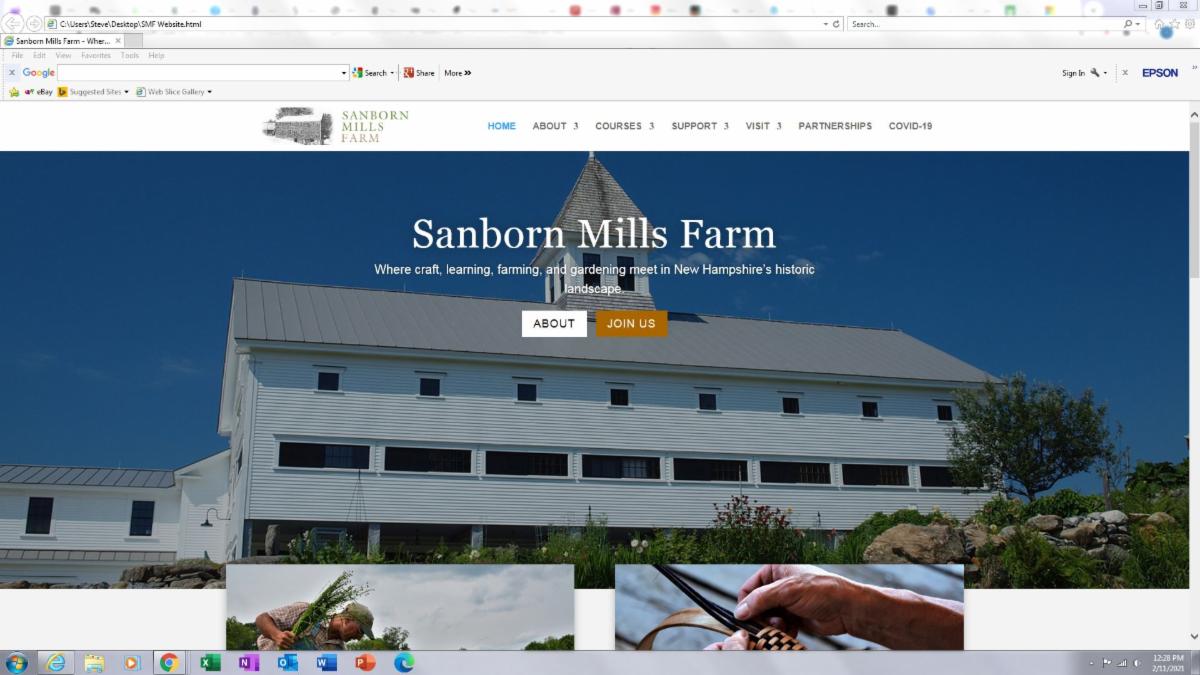
In that spirit, we invite you to stop by www.sanbornmills.org to visit the Farm’s new website. The URL address may be the same as for our old website, but the new site is more than a mere update of existing material. We have greatly simplified our website’s navigation and road map, creating links and flows of information that are intuitive and useful. You probably have had the experience of browsing some organization’s website and finding yourself lost in the weeds of archives and arcana. We designed the new website to make every visit enjoyable and useful.
We also designed the new site to make perusing our workshop offerings and schedule simple. Registration for workshops (when it becomes available) will be easy.
The new website showcases the many activities on the Farm — Farming, Gardening, Education, etc. — and explains the history of not just the Farm as an enterprise with centuries-old ties to our community, but also of several of our historic buildings and structures.
Finally, the new website takes advantage of the abundant photography of our Farm that we’ve gathered over the years. Visitors often comment on the Farm’s singular beauty, and we designed the new website to showcase our setting, our architecture, our animals and crops, our gardens, and our people.
If you have any comments on or suggestions for the new site, please let us know. We’d love to hear from you.
|
|
|
|
|
|
Barns at the Farm: The Sanborn Barn
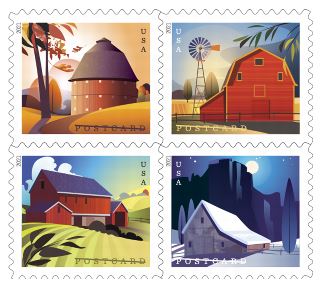
In January, the U.S. Postal Service began issuing four new stamps commemorating American barns. The new stamps show iconic styles of these barns in settings keyed to the four seasons: A round barn surrounded by the hazy light and warm colors of fall; a gambrel-roofed barn in summer;a forebay barn in an early spring countryside; and a Western barn on a winter’s night. The compelling stamps were designed by Ashley Walton, with original artwork by Kim Johnson.
At Sanborn Mills Farm, we know something about barns. We have restored and/or relocated and rebuilt four barns, with a fifth planned for construction this year up at the Merrill Farm.
Most first-time visitors to Sanborn Mills Farm find their gaze immediately pulled to the handsome, commanding presence of the Sanborn Barn, which is the largest of our barns and takes center stage at our main location. Indeed, the Sanborn Barn is such a defining feature of the Farm that a photo of this barn is the banner photo on the Farm’s new website (see above).
Originally constructed in the 1850s to house dairy cows, the Sanborn Barn comprises three levels: the hay mow at the top, originally for hay storage; the “tie up,” or main, floor, accessed by the large double-door on the north side; and the down cellar at the bottom, which was originally used to store manure and then, beginning by the 1940s, for a milking parlor. At some point the structure was expanded by the addition of two more “bents,” or timber frames. Today it is more than 80 feet long and about 40 feet wide, which is especially large for a New Hampshire barn.
There are several features that make the Sanborn Farm unique among barns in northern New England. For example, a slaughter wheel was hung from a bent toward the south end of the barn, which is contrary to the usual practice of dressing meat on the north or east (and cooler) sides of barns, which suggests the Sanborn Barn may have been moved at one time, though there is no structural evidence this is the case. Also, the barn originally had double-bracing that connected to the outer posts, whereas most barns have single braces, and trapezoidal trusses were eventually added to the original framing for strength; the top corners of these trusses connect to the bents with two-inch iron rods, and the bents connect to the floor below with similar two-inch iron rods. This system transferred the weight of the roof and the wooden tie-up floor to the robust outside posts, allowing for a larger barn and also negating the need for interior posts in the barn’s down cellar below the tie-up floor. When the down cellar was used for manure storage, interior posts would have rotted from the manure quickly and would have required frequent replacement.
Renovation work began in 2015, led by Steve Fifield, who restored the barn’s timber framing. One discovery made during the restoration involved the outside posts on the east side of the barn; the posts were telephone poles scabbed into place, suggesting that the original posts rotted over time and at some point were replaced. The restoration included adding windows to every side of the barn, making it one of the very few, and perhaps unique, barns in New England to bring in light from the north, south, east, and west.
Over the past 20 years, Sanborn Mills Farm has used the Sanborn Barn to house or shelter several kinds of farm animals, including sheep, goats, chickens, horses, donkeys, and cattle. The hay mow was used for hay storage prior to construction of the Grano Barn near the Red House, and will be used to display old farm equipment. The open, windowed main floor of the Sanborn Barn is used to host gatherings and workshops, and is a meeting place during Open Farm Day in the summer.
In 2016, work began to convert the old down cellar of the Sanborn Barn into a commercial-grade kitchen and dining hall; with that work now nearly complete, the kitchen and dining hall will be ready for students and guests when in-person workshops and visits can resume post-pandemic.
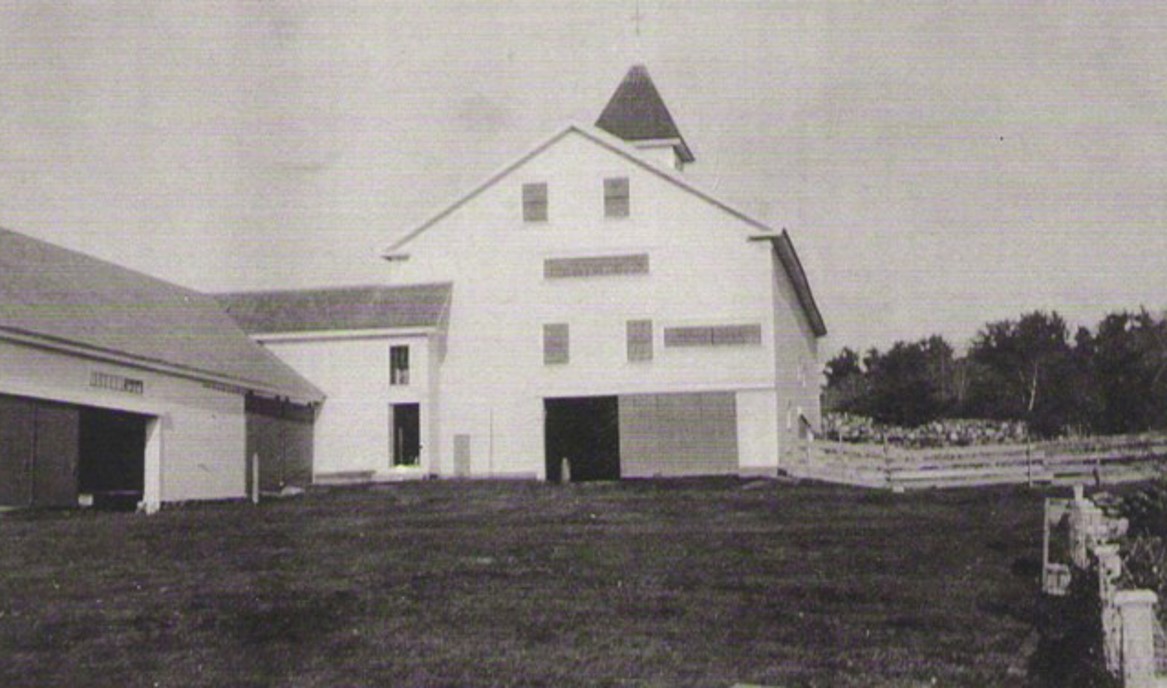
The Sanborn Barn in 1918.
Photo Credits:
Top photo by Steve Bjerklie.
Stamps courtesy U.S. Postal Service
Historic Sanborn Barn Photo courtesy Colin Cabot.