
SHARE:

 |
At Sanborn Mills Farm, preserving the past and planning for the future go hand in hand! May 2019 eNews 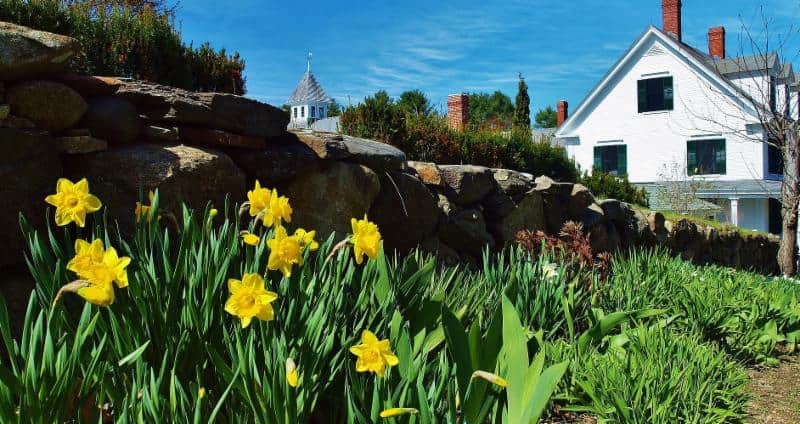
Space Still Available In These Workshops . . .
Program Manager Molly Bolick reminds friends of Sanborn Mills Farm that there’s still space available in a few upcoming workshops, including:
Also, Save the Date — Sunday, July 28, 2019 — for Sanborn Mills Farm’s annual Open House!
Restoration Continues on Historic Threshing Machine
Since last November, Farm Manager Ray Ramsey has spent much of his time during the cold months restoring the historic 1919 Model No. 26 Sterling Thresher that the New Hampshire Farm Museum in Milton, N.H., donated last year to Sanborn Mills Farm. There are still a few moving parts to be installed, but already Ray can demonstrate the Thresher’s basic function. The aim is to have the restoration completed in time for threshing this Fall’s wheat crop. Threshing involves removing the wheat berries from the head of the wheat stalk. For centuries this was accomplished manually, an arduous physical task that involved beating the stalks with sticks on a hard surface. In 1786 a Scotsman named Andrew Meikle invented the first threshing machine, and, like the cotton gin, it revolutionized farming and agriculture. Indeed, in Great Britain the threshing machine was partly responsible for the labor unrest in 1830 that became known as the “Swing Riots”: farm laborers protested the mechanization in agriculture that was eliminating many traditional jobs.
In the United States “Machine threshing really got started in this country in the big wheat farms out West, in Washington state and Oregon. Gradually it came this way. I think that’s a big reason why our Sterling Thresher survived — after threshing machines came combines, which are much more sophisticated and can do a lot more, and while the western U.S. was using combines, in New Hampshire threshers were still in use.”
He adds that the The Sterling machine is designed to be pulled by draft animals and powered by a tractor. During the fall harvest, Ray will move the Sterling Thresher into place with oxen, then use the 1949 Farmall M tractor (another International Harvester machine) to power the machine using a flat belt.
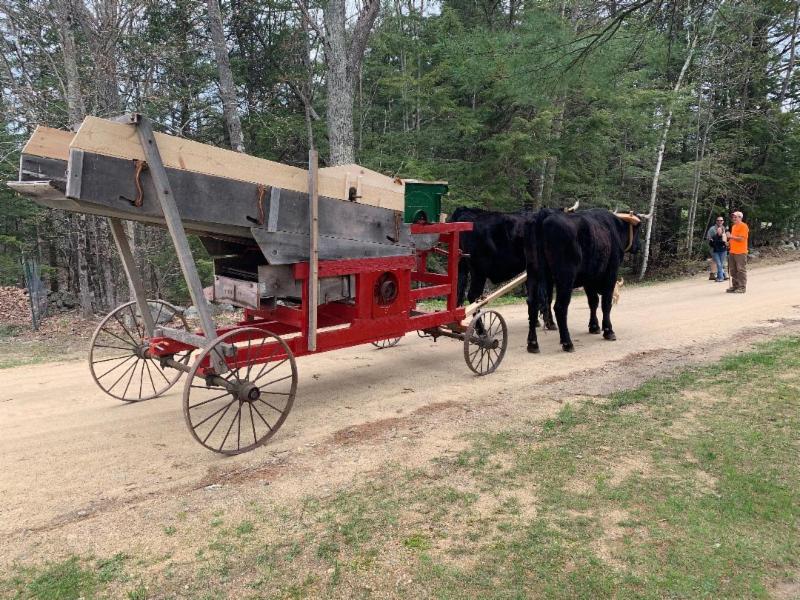
As Farm Manager Ray Ramsey comments, the Sterling Thresher looks complicated, with a lot of moving parts, “but when I took it completely apart for the restoration, it really is the simplest thing.”
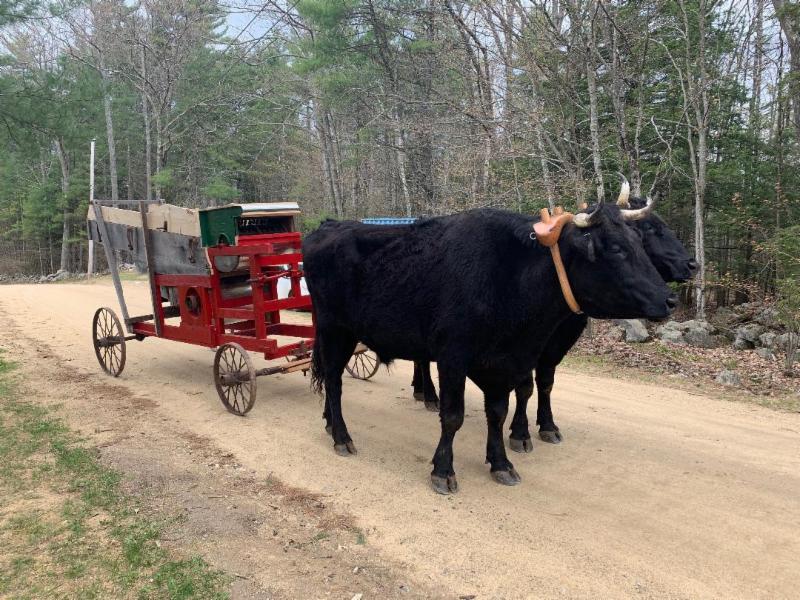
The partially restored Sterling Thresher on its way to the barn for its restoration completion.
Picking New Hampshire’s “Best” Crop
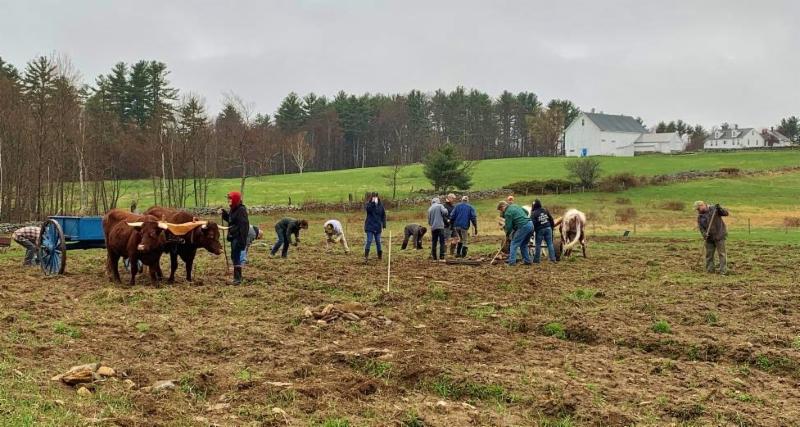
Engaging in a time-honored springtime farming tradition in New Hampshire: rock picking.
The oldest joke in New Hampshire farming has it that the very best crop the state grows, year after year, is… rocks. Most farmers, including Farm Manager Ray Ramsey, will tell you it’s always been true and still is. “The ancient glaciers did not do farmers here any big favors,” he points out. So under gray skies on May 7, Ray assembled a team to participate in a time-honored springtime New Hampshire farm tradition: rock picking. The 1.25-acre field up at the Merrill Farm had been plowed the previous week, and as usually happens, plowing brought up rocks from the dirt — lots and lots of rocks. Filling two stone boats and a cart, the rock-picking team of 15 staff members and friends loaded each stone boat six times and the cart five times. And even that wasn’t all the rocks. Ray says that rocks smaller than fist-size are left behind. “Picking rocks is like raising a teenager,” he laughs. “You pick your battles. If the plow skipped over it, we left it behind.” Another truism about rock-picking, he adds, is that “every rock has a friend.” Why do so many rocks appear year after year? Blame it on those ancient glaciers, which left behind an uncountable number of rocks as they receded, and on winter and frozen ground. When water in the ground freezes, it expands, pushing rocks toward the surface. Once the snow melts and plowing can begin, a new “crop” of rocks is ready to be literally plowed into and then picked. The rocks collected on the plowed field at the Merrill Farm will eventually be used elsewhere on Sanborn Mills Farm for stonewall repair and other uses.
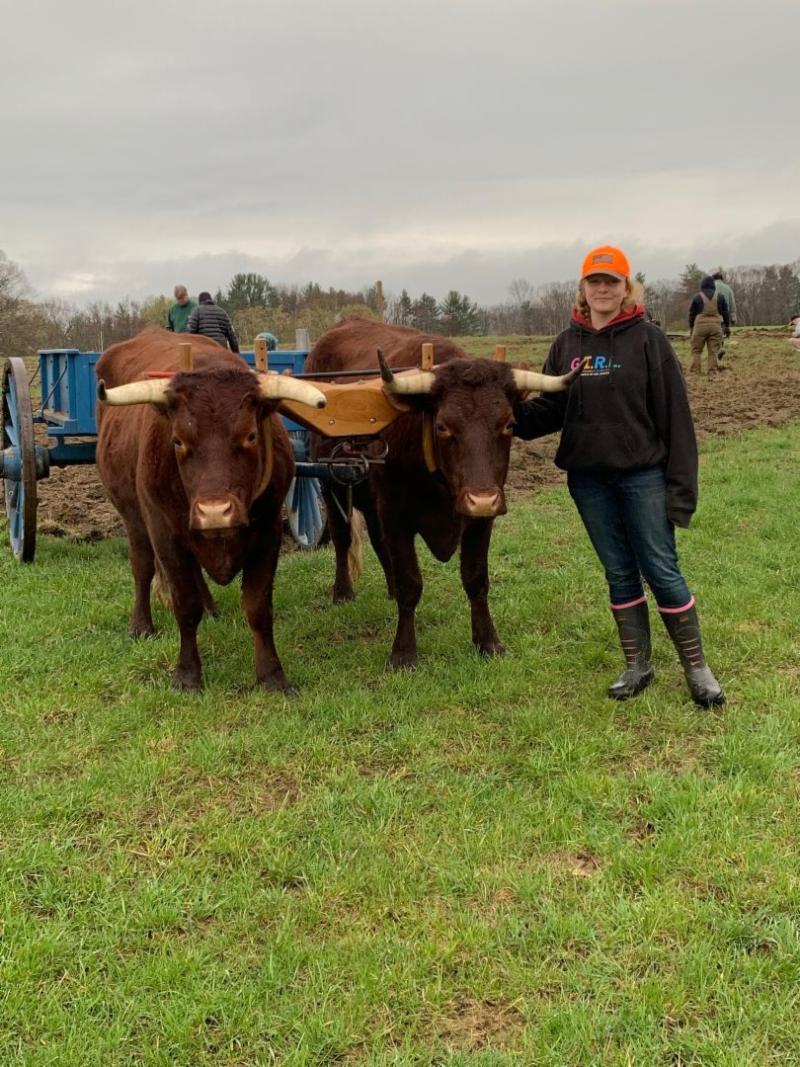
Emma Ramsey, Farm Manager Ray Ramsey’s daughter, poses beside the oxen team pulling the rock cart on Rock-Picking Day.
Just Another [Rock] In the Wall 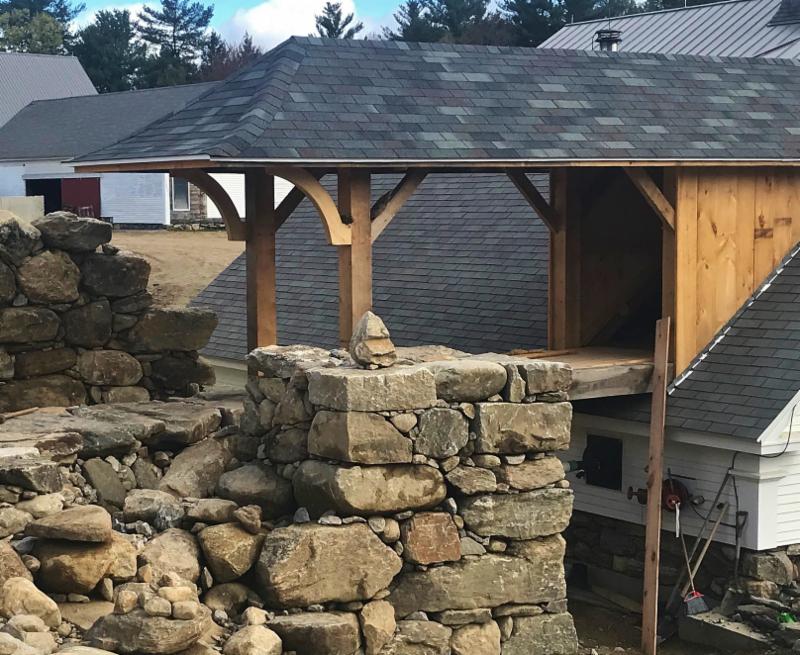
Part of the rock work creates access to the new timber-frame bridge that is the second (and wheelchair-accessible) egress for the seven bedrooms in the new Carriage Barn. Beginning April 22, work has continued on a series of rock walls just behind the Main House at Sanborn Mills Farm that, when completed, will provide code-required egress from the seven bedrooms in the New Carriage Barn to new garden terraces being developed this summer. The work has been delayed off and on by rain; dry-laid stone walls need to be free of dirt and mud when they are built in order to remain stable. When the rocks are wet or slick with mud or caked with dirt, it’s like building a wall with marbles.
The work involves rocks of a wide variety of sizes, including some impressive boulders. Ken has been working closely with Oli Fifield, Logan Clough, and Jeremy Morse. Even in a rain-shortened period, the team has accomplished an enormous amount of work. More than 100,000 yards of material have been removed from the site to allow gardens and two 30,000-gallon water tanks (for the fire suppression system in the Carriage Barn and the Sanborn Barn) to be built where once a hill towered over the Main House and encroached on the rear of the old carriage barn. 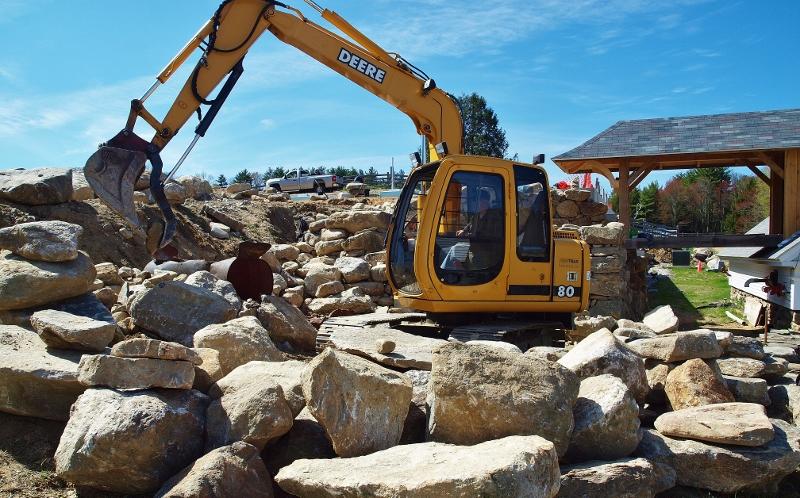
Equipment operator Ken Magoon uses a backhoe to grab and place the larger rocks used in the new walls.
Photo Credits
Photo of timber-frame bridge with rock work by Colin Cabot.
All other photos by Steve Bjerklie.
The partially restored Sterling Thresher on its way to the barn for its restoration completion.
Sanborn Mills Inc. | 603-435-7314 |
A traditional New Hampshire farm and nonprofit organization dedicated to sustainability, creativity, and preserving folklife skills and agricultural knowledge so that the best of the past can help shape our future.
The partially restored Sterling Thresher on its way to the barn for its restoration completion.
STAY CONNECTED: 


The partially restored Sterling Thresher on its way to the barn for its restoration completion. |
|